hreflang errors: what Polish homepages get wrong
One in six multilingual .pl homepages gets hreflang, canonical or lang wrong, most often a missing self-reference. Codes, x-default and the fixes.


Polish websites with language versions mostly mark them with hreflang, and most of the hreflang errors they make come down to one omission. Of the 7,415 popular .pl homepages we read, 1,151 use hreflang to point to versions in other languages. 17% of those have at least one error on the homepage itself, by Google's hreflang rules or by our two checks of the canonical and <html lang>, and the most common error by far is a page that lists its English or German version but not itself: 12% of them. Codes that aren't valid, such as ua for Ukrainian and cz for Czech, turn up on only 4.1%.
We read the HTML and the response headers of every .pl homepage in the Tranco list of popular sites (opens in a new tab) that answered on 30 October 2026, the same sample as our study of WordPress market share in Poland and the other CMSs of .pl sites, and checked each hreflang set against Google's rules for localized versions (opens in a new tab). The homepage is all we fetched, so this is what a homepage shows: whether the other versions answer back needs those pages too.
- 7,415
- 1,151
- 17%
- 12%
How do Polish websites mark their language versions?
With hreflang link elements in the <head>, almost without exception. An annotation is one <link rel="alternate" hreflang="en" href="…"> per language version, and 1,426 homepages (19%) carry at least one. We count a homepage as multilingual when its set, together with the page's own language, names two languages or more; that leaves out the homepages whose hreflang names no language but their own, which we come back to below.
Google accepts the same annotations in an HTTP header or an XML sitemap. Headers are rare: 14 multilingual homepages send a Link header with hreflang, 4 of them without the HTML tags. We don't read sitemaps, so a site that marks its versions only there counts here as having none.
Nine in ten multilingual homepages name English, and almost half German. Ukrainian is in 18% of the sets, close to Russian.
Polish multilingual homepages point to English first, then German
Share of .pl homepages with language versions whose hreflang set names each language (Polish aside) · 95% intervals
Show the data
| Item | Value | 95% interval | n |
|---|---|---|---|
| English | 91% | 89%–92% | 1,151 |
| German | 45% | 43%–48% | 1,151 |
| Czech | 29% | 27%–32% | 1,151 |
| French | 28% | 25%–30% | 1,151 |
| Spanish | 27% | 25%–30% | 1,151 |
| Italian | 25% | 22%–27% | 1,151 |
| Dutch | 21% | 19%–23% | 1,151 |
| Slovak | 21% | 18%–23% | 1,151 |
| Romanian | 20% | 18%–22% | 1,151 |
| Ukrainian | 18% | 16%–20% | 1,151 |
| Hungarian | 17% | 15%–19% | 1,151 |
| Portuguese | 17% | 15%–19% | 1,151 |
| Russian | 15% | 13%–17% | 1,151 |
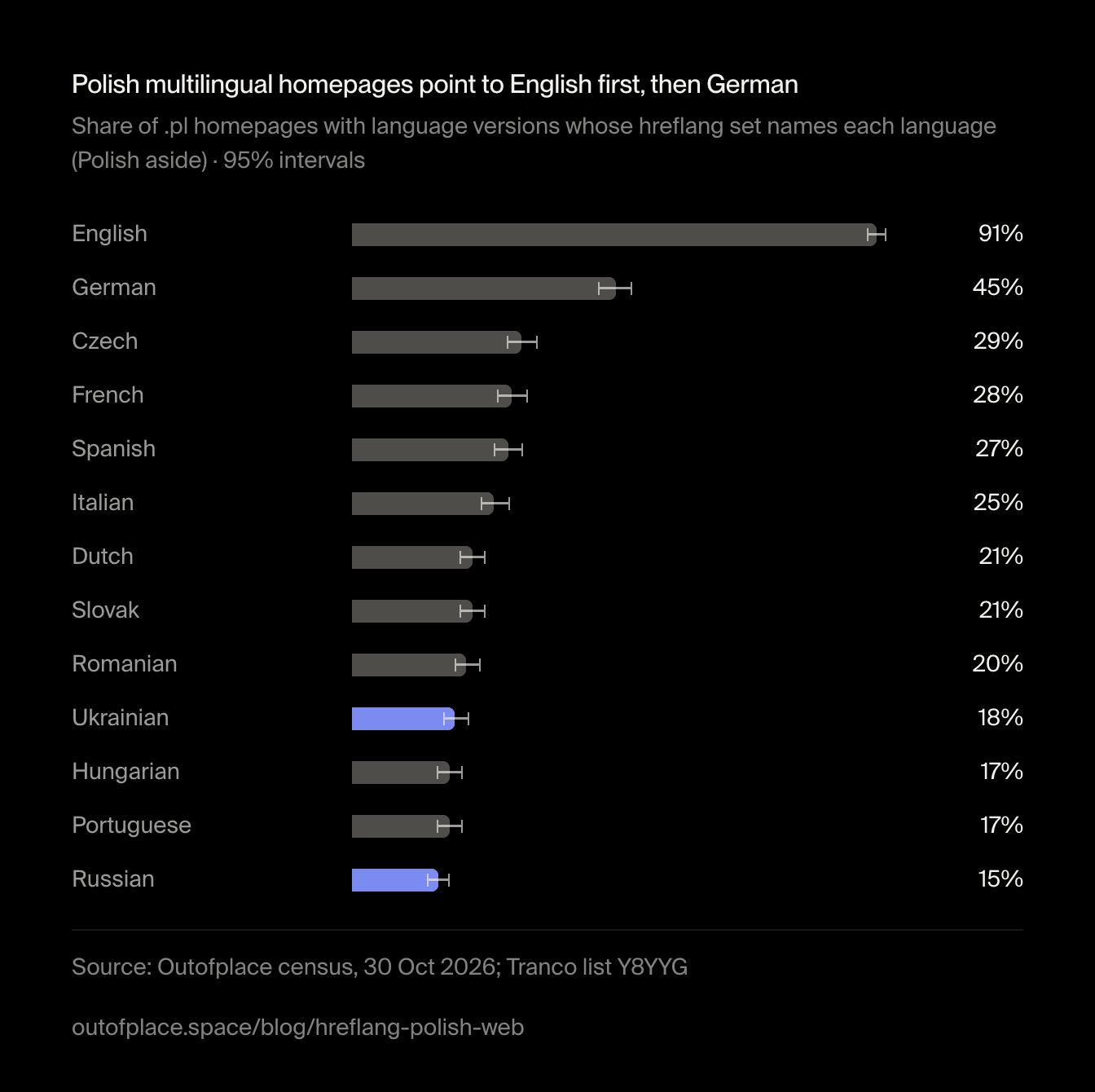
The chart as an image, free to reuse under CC BY 4.0 with credit to Outofplace and a link to this page.
Is hreflang needed for a multilingual site?
Google asks for it when you have versions of a page in different languages or for different regions, so its results can show each user the right one. Most Polish sites with versions do have it. The rule that finds language-switch links (a link to /, en. or ?lang=en on the same site) found 406 homepages that link to another language version and mark none with hreflang; all 12 we checked by hand were real language versions. Another 132 homepages without hreflang load a translation widget that translates the page in the browser, with no separate address for Google to show.
It varies by platform. On Shopify, IdoSell, Magento and PrestaShop, at least nine in ten homepages with language versions mark them with hreflang. Homepages with no CMS we could recognise do it on about three in five, level within the margin with Drupal and the smaller CMSs.
Shop platforms mark language versions with hreflang almost always
Share of .pl homepages with language versions (hreflang for two languages, or a link to a language version) whose hreflang marks them, by CMS or platform · 95% intervals
All homepages with language versions: 74%
Show the data
| Item | Value | 95% interval | n |
|---|---|---|---|
| Shopify | 100% | 93%–100% | 54 |
| IdoSell | 98% | 91%–100% | 60 |
| Magento | 95% | 83%–99% | 39 |
| PrestaShop | 91% | 86%–95% | 164 |
| Other shop platforms | 88% | 73%–95% | 34 |
| JS framework, no CMS seen | 87% | 80%–92% | 123 |
| WordPress | 77% | 72%–81% | 357 |
| Other CMSs and platforms | 68% | 58%–76% | 99 |
| Drupal | 62% | 48%–75% | 45 |
| No CMS detected | 59% | 55%–63% | 582 |
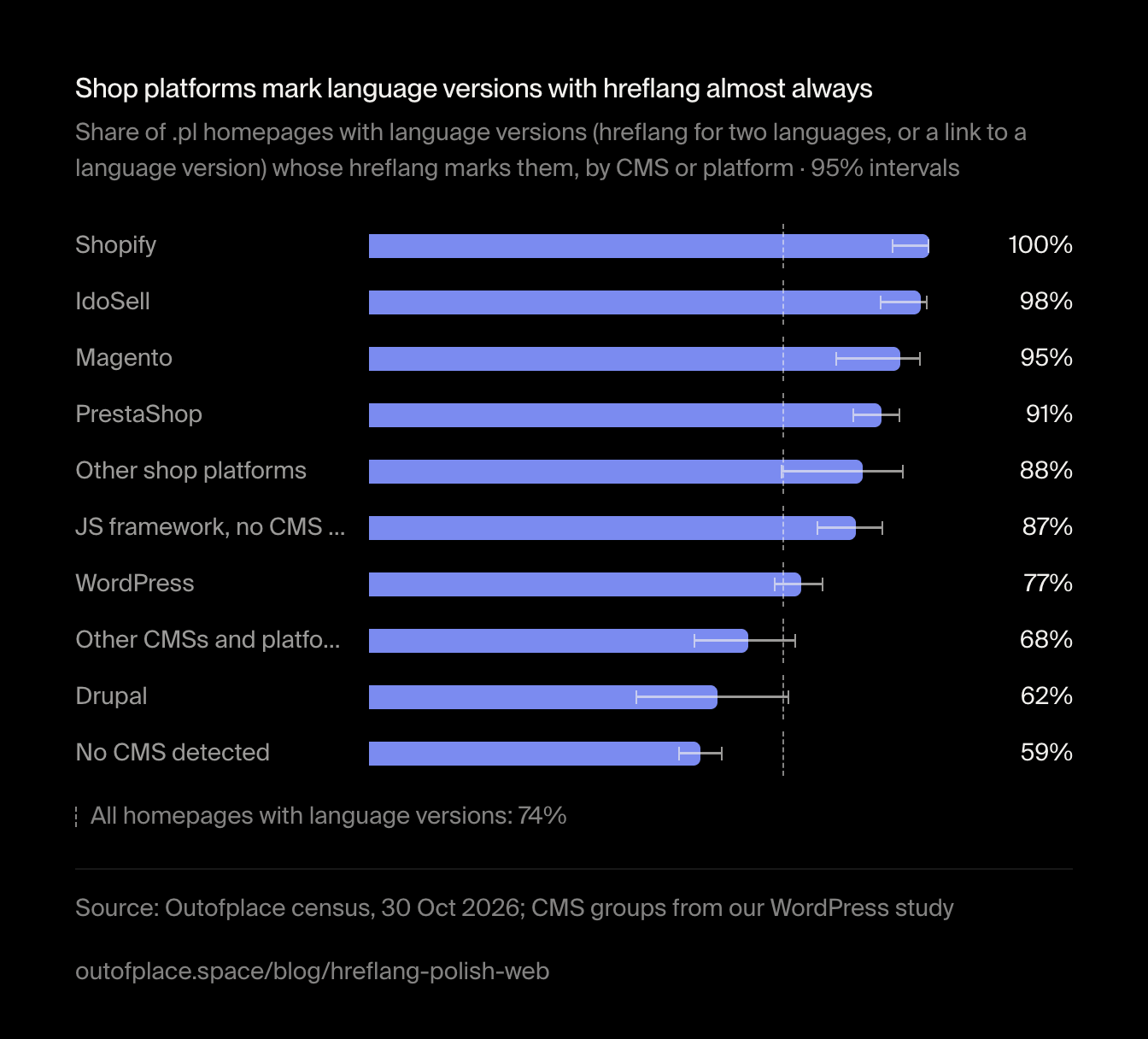
The chart as an image, free to reuse under CC BY 4.0 with credit to Outofplace and a link to this page.
On WordPress the share differs by translation plugin. Every homepage we saw that loads assets of Polylang, TranslatePress, qTranslate or MultilingualPress marks two languages or more with hreflang, though that group is small. WPML homepages do so 60% of the time, and those running an in-browser translation widget such as GTranslate 23%.
On WordPress, every site we saw with Polylang, TranslatePress or a similar plugin had hreflang
Share of WordPress homepages with hreflang for two languages or more, by the translation plugin whose assets the homepage loads · 95% intervals
Show the data
| Item | Value | 95% interval | n |
|---|---|---|---|
| No translation plugin seen | 11% | 9.3%–12% | 1,477 |
| Polylang, TranslatePress, other | 100% | 91%–100% | 37 |
| Translation widget (GTranslate and others) | 23% | 13%–36% | 53 |
| WPML | 60% | 51%–68% | 112 |
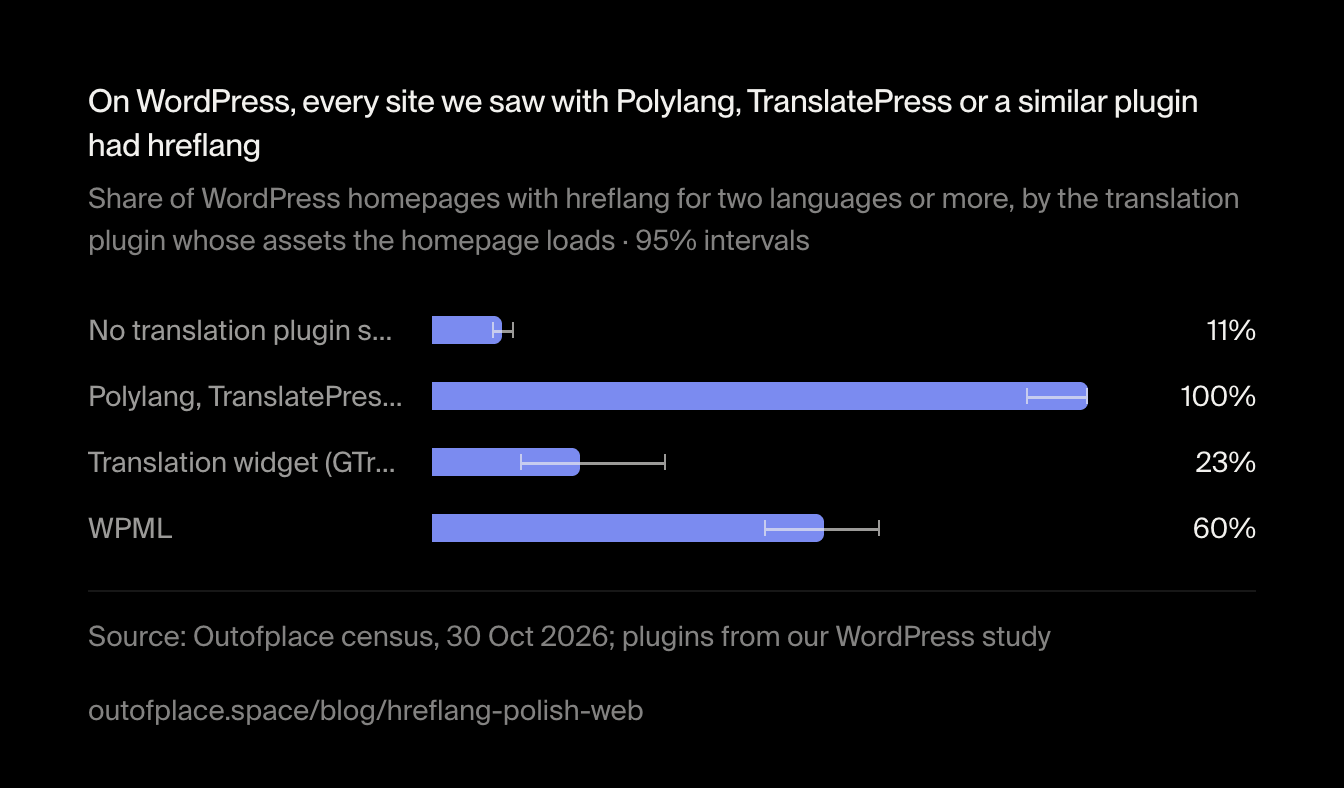
The chart as an image, free to reuse under CC BY 4.0 with credit to Outofplace and a link to this page.
What are the most common hreflang errors?
We checked each multilingual homepage's set against the rules Google states for the method: every version lists itself and every other version, codes are ISO 639-1 languages with an optional ISO 3166-1 alpha-2 region, URLs are fully qualified, and the tags sit in the <head>. We added two checks of our own: a canonical that agrees with the page, and an <html lang> that agrees with the page's own code.
A missing self-reference is the most common hreflang error
Share of .pl homepages with language versions marked by hreflang whose own set fails each check · 95% intervals
Show the data
| Item | Value | 95% interval | n |
|---|---|---|---|
| Any of the errors below | 17% | 15%–19% | 1,151 |
| Doesn't list itself | 12% | 10%–14% | 1,151 |
| A code that isn't valid | 4.1% | 3.1%–5.4% | 1,151 |
| Canonical points away from the page | 3.8% | 2.9%–5.1% | 1,151 |
| A relative URL | 1.6% | 1%–2.5% | 1,151 |
| One code, two addresses | 1% | 0.5%–1.7% | 1,151 |
| html lang names another language | 0.4% | 0.2%–1% | 1,151 |
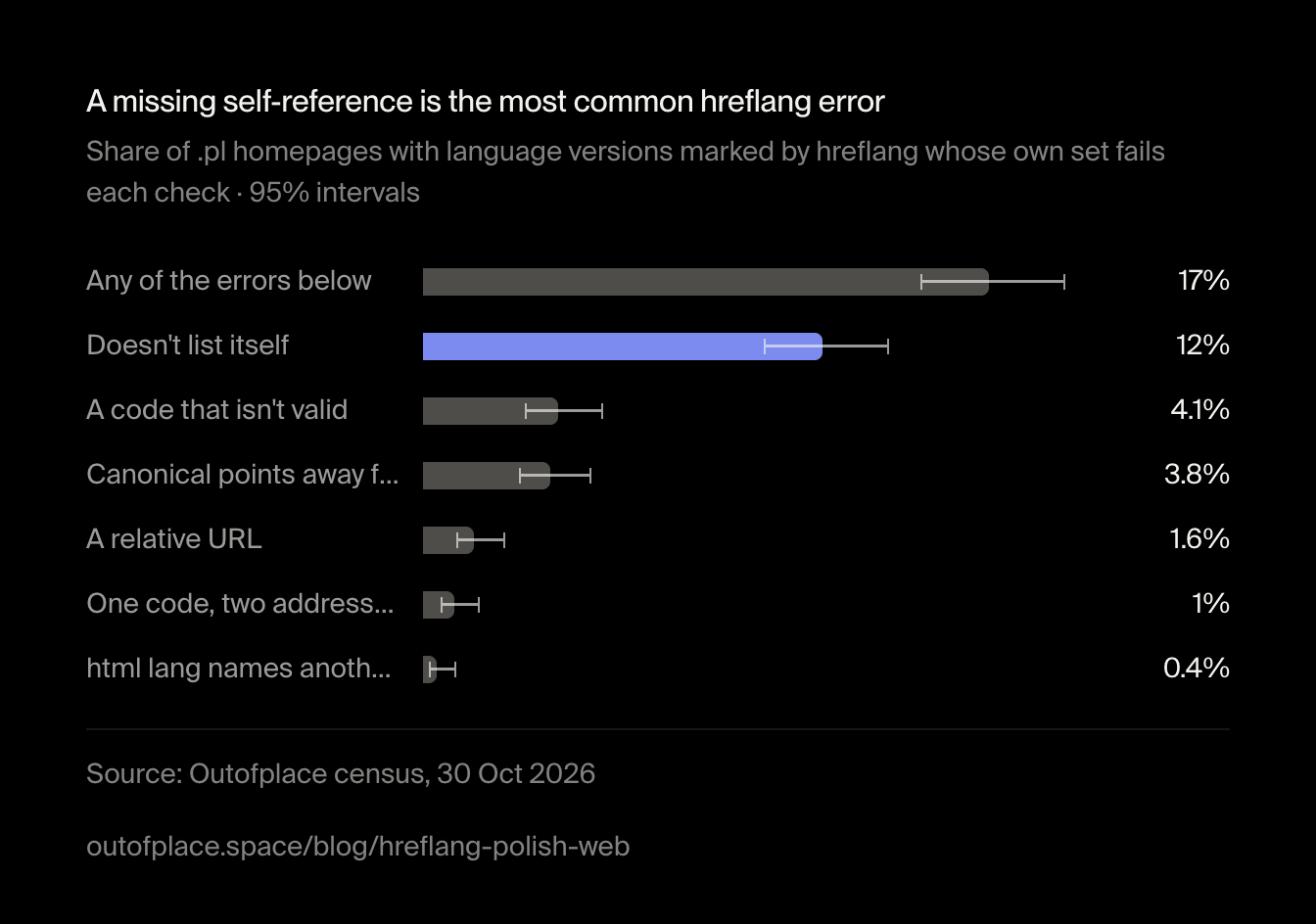
The chart as an image, free to reuse under CC BY 4.0 with credit to Outofplace and a link to this page.
The missing self-reference is about three times as common as the next error. Every other error is on fewer than one homepage in twenty, and the <html lang> almost always agrees with the code the page gives itself: 5 homepages disagree. No multilingual homepage put its tags in the <body>, and none wrote a code with an underscore (en_GB), the locale format many programming languages use.
Does each page need a self-referencing hreflang tag?
Yes. Google's documentation says that "each language version must list itself as well as all other language versions", and that "if two pages don't both point to each other, the tags will be ignored". A Polish homepage that lists only en and de gives the English page nothing to point back to: the English page can list the Polish one, but the Polish one never confirms it.
138 multilingual homepages fall short of that in one of three ways. 98 list no URL of their own at all. 19 name themselves only as x-default, so Google is told this is the fallback, not the Polish version. And 21 list themselves at an address that redirects to the homepage or differs from it by www, the protocol or a trailing slash. That last group looks right in the source and still points at a different URL.
Which hreflang codes are wrong?
Few, and they are predictable. 47 multilingual homepages use at least one code that isn't valid: 26 put a country code where the language goes, and 18 add a region that isn't a country in ISO 3166-1. For Polish sites the two typical ones are the neighbours: cz for Czech, which is cs, and ua for Ukrainian, which is uk. Against 205 homepages that mark Ukrainian correctly, 11 use ua or a ua- code. en-uk (the United Kingdom is gb) turned up once.
| Code | What is wrong | Homepages | Valid form |
|---|---|---|---|
| cz | Country code used as a language | 10 | cs (Czech) |
| ua | Country code used as a language | 10 | uk (Ukrainian) |
| at | Country code used as a language | 4 | de-AT (German, Austria) |
| en-eu | Region that isn't an ISO country | 3 | en, or one tag per country |
| en-xk | Region that isn't an ISO country | 3 | XK is a user-assigned code, not in ISO 3166-1 |
| en-150 | Region that isn't an ISO country | 2 | en, or x-default |
| en-en | Region that isn't an ISO country | 2 | en |
| fr-xk | Region that isn't an ISO country | 2 | XK is a user-assigned code, not in ISO 3166-1 |
| sq-xk | Region that isn't an ISO country | 2 | XK is a user-assigned code, not in ISO 3166-1 |
Most valid sets use the bare language. Of the homepages that list themselves, 721 give themselves a language alone (pl), 263 add the country (pl-pl) and 29 carry both. Both forms are valid. The country only matters when you have versions of one language for different countries, such as de-de and de-at.
Canonical and hreflang together
Google's guide to canonical URLs (opens in a new tab) asks you to "specify a canonical page in the same language, or the best possible substitute language", and says it prefers URLs that are part of hreflang clusters. 44 multilingual homepages (3.8%) contradict their own set: 19 name another language version as canonical, which tells Google the Polish page is a copy of it, and the rest point it at another address or a variant of their own. 12% have no canonical, which isn't an error.
Do errors depend on the CMS?
They differ, though the margins of the smaller groups are wide. Homepages with no CMS we could recognise have an error on more than one in four, level within the margin with the smaller shop platforms, other CMSs and frameworks. On WordPress, PrestaShop, Shopify and IdoSell it is about one in ten. How the same shop platforms compare on speed is in our Core Web Vitals study of Polish online shops.
On WordPress, PrestaShop, Shopify and IdoSell about one in ten hreflang sets has an error
Share of .pl homepages with language versions marked by hreflang whose own set fails at least one check, by CMS or platform · 95% intervals
All multilingual homepages: 17%
Show the data
| Item | Value | 95% interval | n |
|---|---|---|---|
| No CMS detected | 28% | 23%–33% | 344 |
| Other shop platforms | 23% | 12%–41% | 30 |
| Other CMSs and platforms | 21% | 14%–30% | 95 |
| JS framework, no CMS seen | 18% | 12%–26% | 107 |
| Magento | 14% | 5.9%–28% | 37 |
| IdoSell | 10% | 4.7%–20% | 59 |
| Shopify | 9.3% | 4%–20% | 54 |
| WordPress | 9.1% | 6.2%–13% | 275 |
| PrestaShop | 8.7% | 5.1%–14% | 150 |
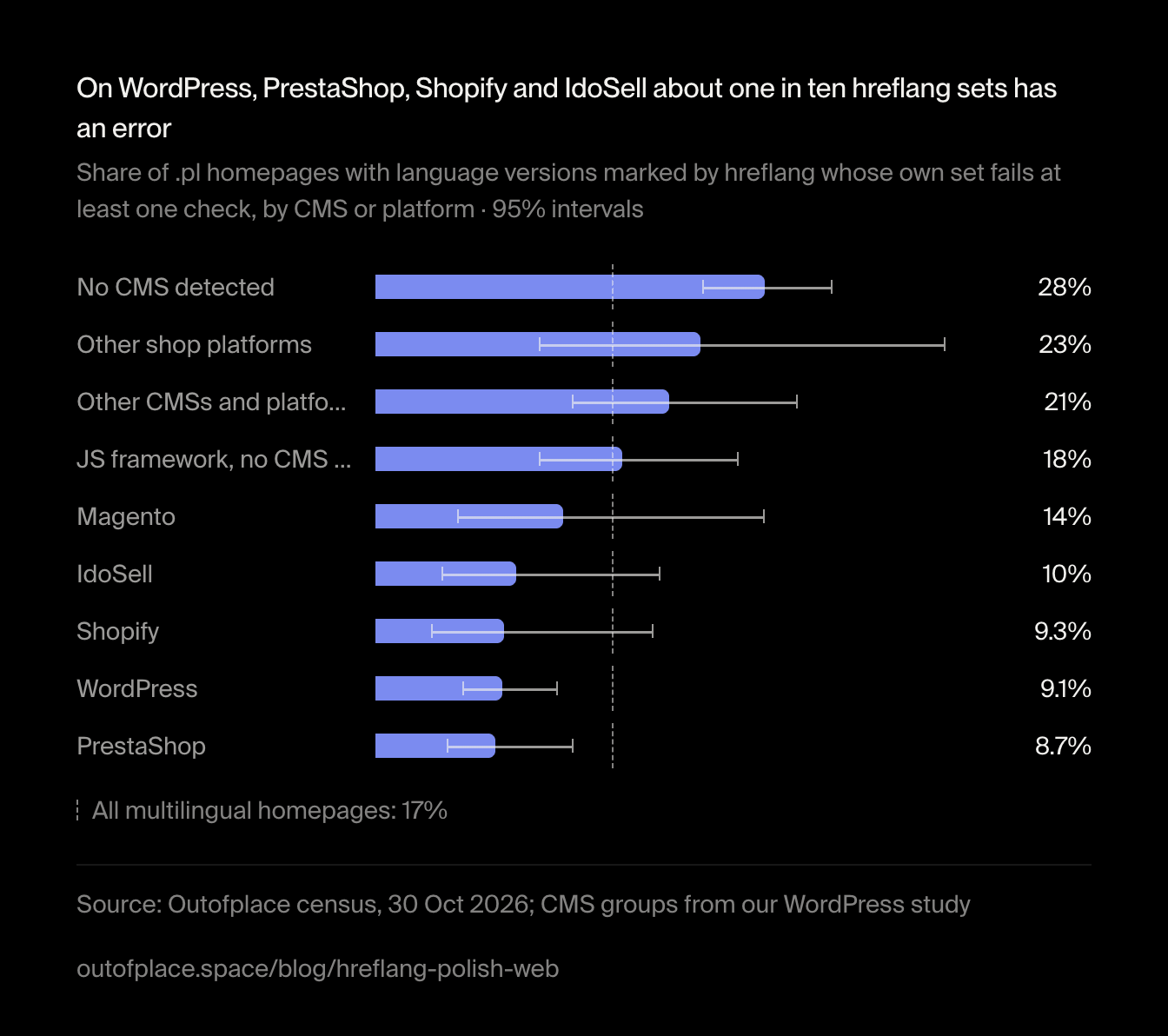
The chart as an image, free to reuse under CC BY 4.0 with credit to Outofplace and a link to this page.
What is x-default and when should you use it?
x-default is the reserved value for the page Google shows "when no other language/region matches the user's browser setting": usually a language chooser, or the version you'd rather show a visitor you know nothing about. It is a recommendation, not a rule, and 51% of multilingual Polish homepages don't have one. For a Polish site whose root is the Polish version, the root can be both pl and x-default; what it shouldn't be is x-default alone.
Folder, subdomain or separate domain?
Folders win. On 60% of multilingual homepages every other version lives in a folder of the same host (/, /), and on 32% on another domain, such as a brand's country domains (.de, .cz) or a .com. Subdomains and a language parameter are rare. Google's guide to multi-regional sites (opens in a new tab) describes all of them, and hreflang works the same way in each.
Most Polish sites put their language versions in folders
Where the other versions in a multilingual .pl homepage's hreflang set live, x-default aside · 95% intervals
Show the data
| Item | Value | 95% interval | n |
|---|---|---|---|
| Folders (/en/) | 60% | 57%–63% | 1,151 |
| Separate domains (.de, .com) | 32% | 29%–34% | 1,151 |
| A mix | 5.4% | 4.2%–6.9% | 1,151 |
| Subdomains (en.) | 1.3% | 0.8%–2.1% | 1,151 |
| A parameter (?lang=en) | 1.2% | 0.7%–2% | 1,151 |
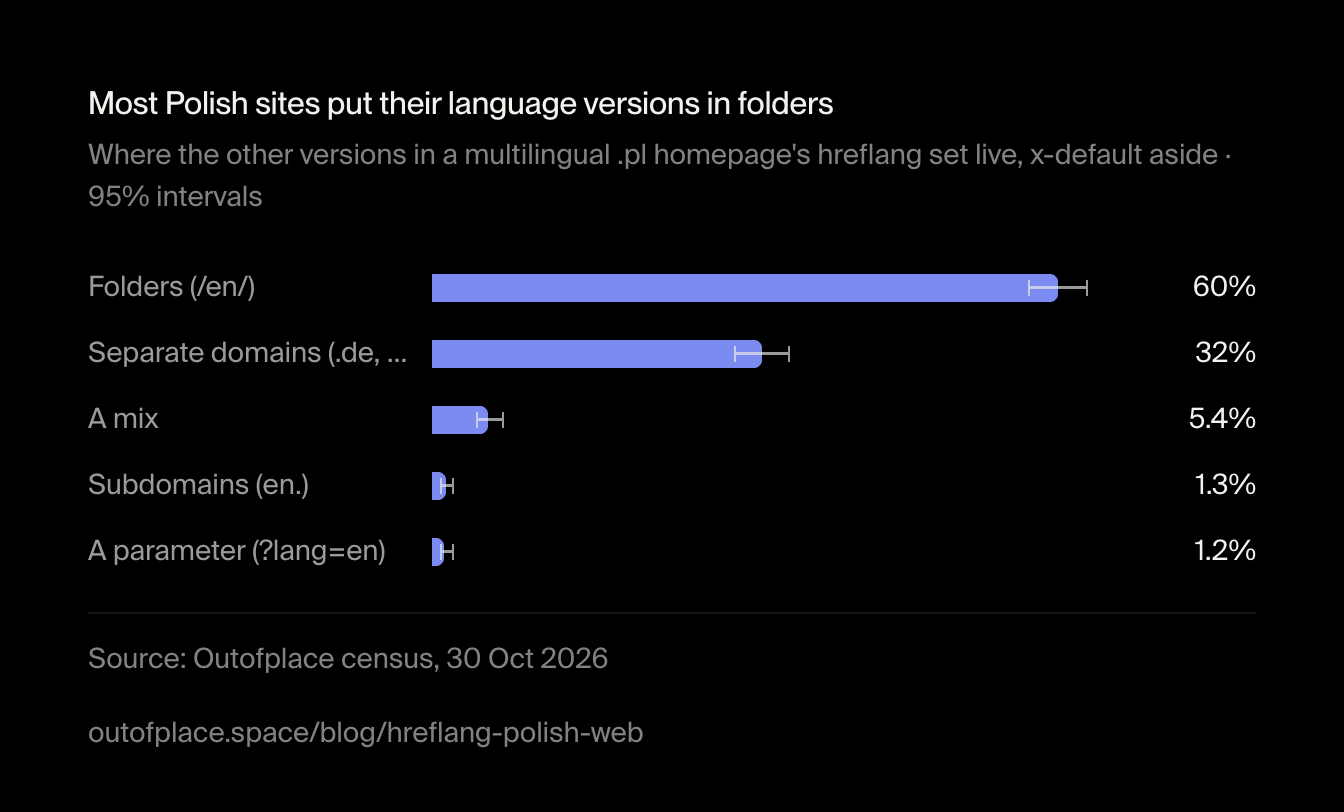
The chart as an image, free to reuse under CC BY 4.0 with credit to Outofplace and a link to this page.
hreflang that points to gambling pages
122 homepages (1.6% of the sample) carry hreflang that names no language besides their own and points at another address; on 70% of them the canonical points there too. We checked 12 of them by hand, drawn at random, judging each target by its URL and the homepage it sits on, and all 12 pointed at online casino or betting pages: on other domains, on subdomains of the site, or in a folder of it. A sample that small can't tell what every one of these homepages is, but such tags are easy to miss in a page's source. If your homepage's hreflang names a page you don't recognise, look at it as a possible security problem, not only an SEO one.
Does Google use the HTML lang attribute?
Not for language. Google's guide states that it "doesn't use hreflang or the HTML lang attribute to detect the language of a page"; it reads the content. The attribute still matters to screen readers, browser translation and hyphenation. Of the 6,472 homepages whose text reads as Polish, 6.7% have no lang and 2% say they are English.
Bing is the other engine Polish sites serve. Its webmaster blog, in a post on duplicate content from December 2025 (opens in a new tab), tells site owners to "use hreflang to define language and regional targeting" and to audit hreflang relationships with canonicals and redirects.
How to fix hreflang errors
For each language version of a page, in this order:
List every version, the page itself included
The set is the same on every version: each one lists itself and all the others, with full
https:/URLs of the canonical address, not one that redirects./ <link rel="canonical" href="https://www.example.pl/" /> <link rel="alternate" hreflang="pl" href="https://www.example.pl/" /> <link rel="alternate" hreflang="en" href="https://www.example.pl/en/" /> <link rel="alternate" hreflang="uk" href="https://www.example.pl/uk/" /> <link rel="alternate" hreflang="x-default" href="https://www.example.pl/" />Use language codes, and countries only when they differ
ISO 639-1 for the language (
cs,uk,de), then an ISO 3166-1 country only when you have versions per country (de-at). Never a country alone (cz,ua,at), neveren-uk(the United Kingdom isgb), never an underscore.Point the canonical at the page itself
Each version is its own canonical. A Polish page whose canonical is the English one tells Google it is a duplicate of it.
Add x-default for visitors no version matches
Point it at the language chooser or at the version you'd show anyone else. On a Polish-first site that is often the Polish root, listed as both
plandx-default.Set html lang to the page's language
<html lang="pl">on the Polish version,lang="en"on the English one. Google doesn't read it for language, but screen readers and browsers do.Check the other side
Open each version's source and confirm it lists the same set. Search Console no longer reports hreflang errors: Google deprecated the International Targeting report (opens in a new tab) and says it will keep supporting and using hreflang tags. A crawler that follows the alternates is the way to check return links across the site.
How we measured
How we checked the two groups the rules can only guess at
We drew 12 homepages at random (seed 7) from each of two groups and read their tags and link targets by hand. Homepages with links the rules take for language versions but no hreflang for two languages: 12 of 12 were language versions (switchers to /, en. subdomains, ?lang=en). Homepages whose hreflang names no language besides their own and points away: 12 of 12 pointed at gambling pages, judged by the target's URL and the homepage it sits on. The labels are in the dataset. The switch-link rule finds language versions; it is no proof that a site without such links has none, so the share of sites with versions that use hreflang is an upper bound.
What this data can't tell you
We saw the homepage only. Return links need the other versions fetched, so a set that is complete on the homepage can still be broken on the English page; redirects, errors and noindex on the alternate URLs are invisible too. Annotations in XML sitemaps and those a script inserts aren't read, so a site that uses only its sitemap counts as having no hreflang. Homepages over 1 MiB (319) were cut. Nothing here measures rankings or traffic: the CMS and plugin differences are correlations between sites that differ in other ways too.
What are the most common hreflang errors?
On the Polish homepages we read, the most common by far is a page that lists its other language versions but not itself: 12% of multilingual homepages. Codes that aren't valid (ua for Ukrainian, cz for Czech) and a canonical that points away from the page come next, at about 4.1% each.
Does each page need a self-referencing hreflang tag?
Yes. Google's documentation says each language version must list itself as well as all other language versions. A Polish homepage that lists only its English version is missing its own pl tag, and the English page can't confirm a return link to it.
What is x-default and when should I use it?
x-default is the reserved hreflang value Google uses when no other language or region matches the user's browser setting: usually a language chooser or the main version. It is recommended, not required. About half of multilingual Polish homepages (51%) have none.
Does hreflang improve rankings?
Google describes hreflang as a way to help Search point users to the version of a page in their language or region. Our data measures no rankings. What a broken set costs is that choice: if two pages don't both point to each other, Google ignores the tags.
Does Bing support hreflang?
Yes. Bing's webmaster blog (December 2025) tells site owners to "use hreflang to define language and regional targeting", with a link element example, and lists hreflang relationships among the things to audit.
How do I find hreflang errors in Search Console?
You can't any more: Google deprecated the International Targeting report, which used to list hreflang errors, and says it will keep supporting and using hreflang tags. Check the tags in the page source or with a crawler, version by version.