nosnippet on the Polish web: almost nobody limits Google
7 of 7,785 .pl homepages limit Google's snippet, while a quarter ask for bigger previews. None of the 1,015 that block AI crawlers in robots.txt use nosnippet.


Almost no Polish site uses nosnippet or any other rule that limits what Google and AI answers may quote. We read the homepages of the 7,785 .pl sites in the Tranco list of popular sites (opens in a new tab) that answered with HTML, and only 7 limit their text snippet. Far more ask for the opposite: 25% tell Google it may show large image previews, snippets of any length or both, mostly because WordPress or an SEO plugin writes that by default.
This is the on-page side of the question we asked in our study of AI crawlers on the Polish web. robots.txt decides which crawlers may fetch a page; snippet rules decide what a search engine may show of a page it already has, and Google says nosnippet also keeps a page's text out of AI Overviews and AI Mode. The sites that block AI crawlers in robots.txt don't use it: of the 1,015 homepages whose robots.txt blocks an AI training crawler, 0 limit their snippet.
- 7,785
- 25%
- 7
- 0
What nosnippet, max-snippet and max-image-preview do
Search engines read a page's robots rules from a <meta name="robots"> tag in the HTML or from an X-Robots-Tag header in the server's response. A tag named googlebot or bingbot addresses one crawler only. Most rules people know decide whether a page is indexed (noindex) or its links followed (nofollow). A second group decides how much of an indexed page a search engine may show. Google's robots meta tag documentation (opens in a new tab) (last updated 24 March 2026) lists them:
nosnippet: no text snippet or video preview. It applies "to all forms of search results", AI Overviews and AI Mode included, and "will also prevent the content from being used as a direct input for AI Overviews and AI Mode".max-snippet:[number]: at most that many characters of text;0is the same asnosnippet,-1lets Google choose.max-image-preview:none|standard|large: no image preview, a default-sized one, or one as wide as the screen.max-video-preview:[number]: at most that many seconds of video preview.data-nosnippet: an HTML attribute that keeps one part of a page out of snippets.
When rules conflict, Google applies the more restrictive one. Bing gives two older rules a meaning for its AI answers, and a third family, noai and noimageai, has no standard behind it. We read all of them on every homepage.
A quarter of Polish homepages ask Google for more
Just over half the homepages carry a robots meta tag at all (54%), and many of those say only index, follow, which is what search engines assume anyway. Of the meta tag and header rules that change what Google shows, the common ones all widen it. Each of those rules that would narrow it is on fewer than one homepage in fifty; the data-nosnippet attribute, which works inside the page, comes later.
Polish homepages ask Google for bigger previews, almost never smaller ones
Share of .pl homepages stating each robots rule in a meta tag or the X-Robots-Tag header · rules that widen what Google shows in cool tones, rules that limit it in warm ones · n = 7,785 · 95% intervals
Show the data
| Item | Value | 95% interval | n |
|---|---|---|---|
| max-image-preview:large | 25% | 24%–26% | 7,785 |
| max-snippet:-1 | 17% | 17%–18% | 7,785 |
| max-video-preview:-1 | 17% | 16%–18% | 7,785 |
| noarchive | 1.6% | 1.3%–1.9% | 7,785 |
| noindex | 1.1% | 0.9%–1.4% | 7,785 |
| noai | 0.3% | 0.2%–0.4% | 7,785 |
| nocache | 0.2% | 0.1%–0.4% | 7,785 |
| max-image-preview:standard | 0.1% | 0.1%–0.3% | 7,785 |
| max-snippet:n | 0.1% | 0%–0.1% | 7,785 |
| nosnippet | 0% | 0%–0.1% | 7,785 |
| max-snippet:0 | 0% | 0%–0.1% | 7,785 |
| max-image-preview:none | 0% | 0%–0.1% | 7,785 |
| noimageai | 0% | 0%–0.1% | 7,785 |
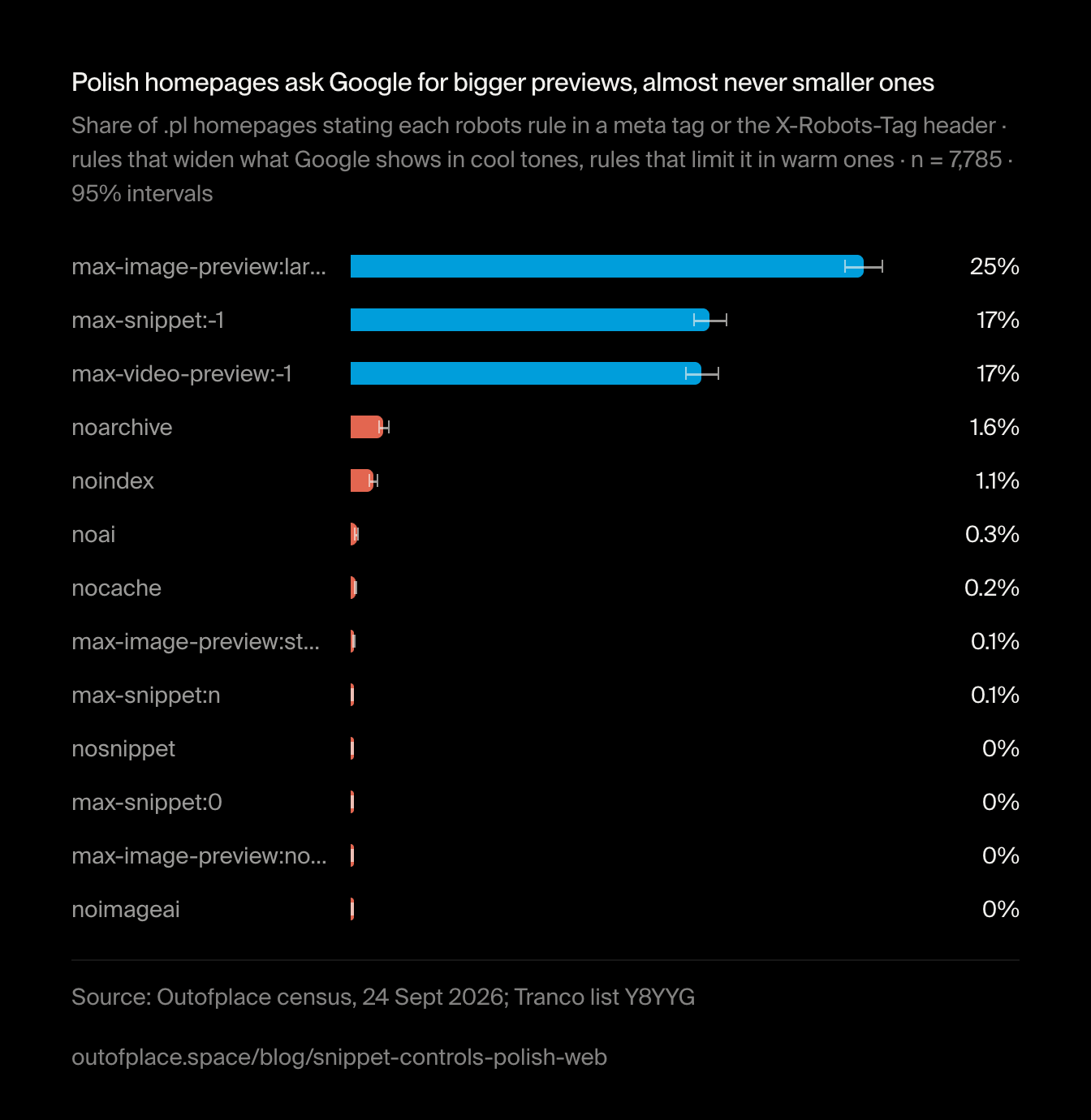
The chart as an image, free to reuse under CC BY 4.0 with credit to Outofplace and a link to this page.
Put together, 19 homepages limit any preview, text, image or video, and 7 limit the text, with nosnippet or a max-snippet length. Another 84 homepages carry noindex that Google would apply and keep out of search results altogether. These counts are the rules Google would follow; the chart and the table at the end count every mention, including tags addressed to other crawlers.
Where max-image-preview:large comes from
max-image-preview:large is a default of the most common software. WordPress 5.7 (opens in a new tab) (March 2021) adds it to every site that allows search engines, and Yoast SEO's specification (opens in a new tab) says the plugin writes max-snippet:-1, max-image-preview:large, max-video-preview:-1 on each public page by default. The census shows the defaults at work: the share asking for large previews rises and falls with the software behind the page.
Large image previews follow the software behind the site
What .pl homepages tell Google about image previews, by the SEO plugin or CMS behind the page · Yoast n = 907, Rank Math n = 239, All in One SEO n = 100, other WordPress n = 591, not WordPress n = 5,948
- Limited (standard or none)
- No rule (default size)
- Large previews asked for
Show the data
| Item | Limited (standard or none) | No rule (default size) | Large previews asked for | n |
|---|---|---|---|---|
| Yoast SEO | 0.1% | 4% | 96% | 907 |
| Rank Math | 0% | 5.4% | 95% | 239 |
| All in One SEO | 0% | 10% | 90% | 100 |
| Other WordPress | 0.5% | 33% | 66% | 591 |
| Not WordPress | 0.1% | 94% | 6% | 5,948 |
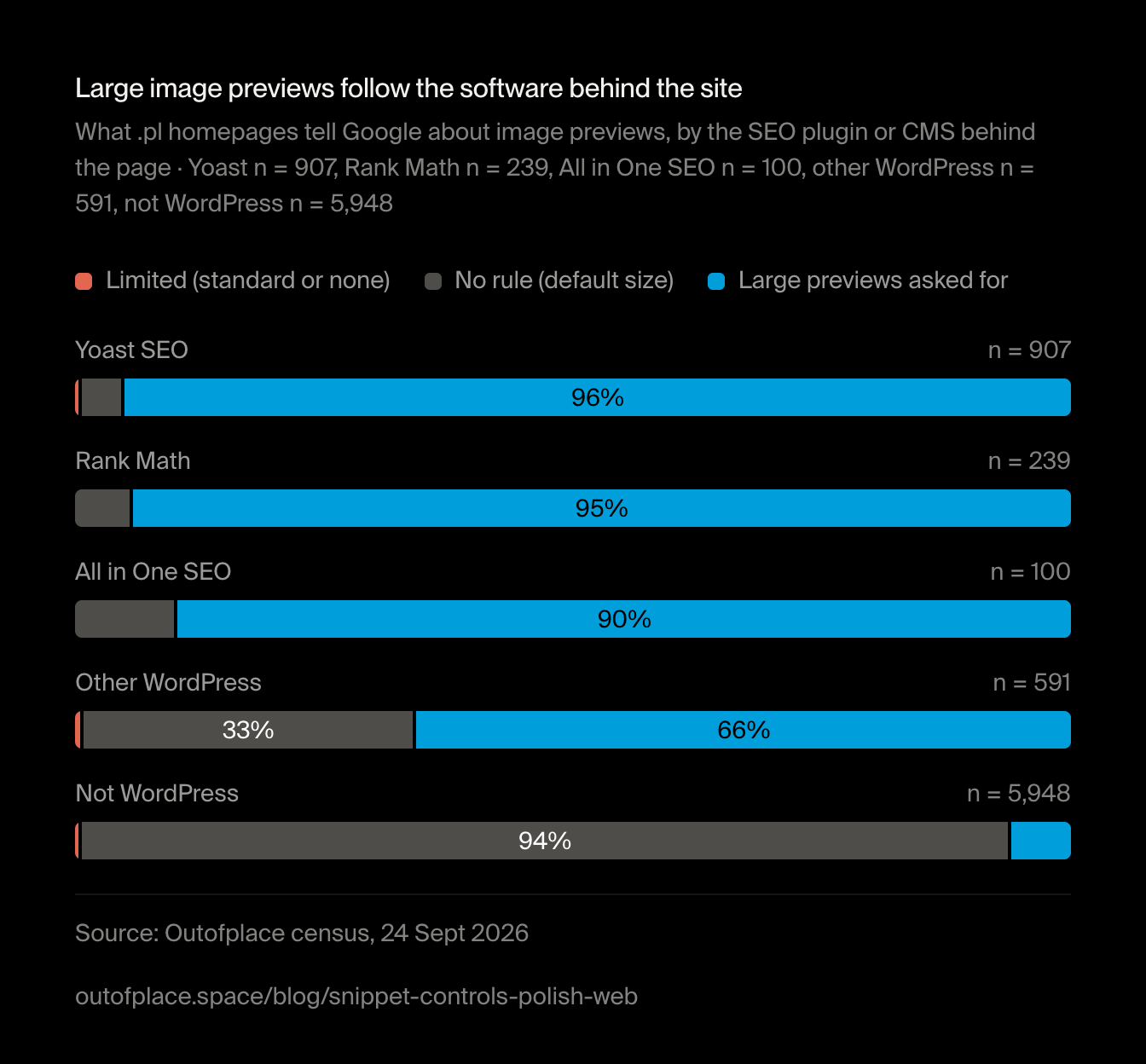
The chart as an image, free to reuse under CC BY 4.0 with credit to Outofplace and a link to this page.
Nine in ten or more homepages with Yoast SEO, Rank Math or All in One SEO ask for large previews. Other WordPress sites ask less often, 66%, perhaps because some switch the core default off or run a theme that prints its own tag; outside WordPress, 6% do. Of all the homepages asking for large previews, 61% run an SEO plugin we recognise.
That is a reasonable default for a site that wants its pictures seen. It does mean that most of the requests for bigger previews match what the software writes by default, and that the opposite, limiting what is shown, is something almost nobody asks for.
noai: one shop platform's header
noai and noimageai are unofficial rules that ask AI services not to use a page's text or images. They are not among the rules in Google's documentation. In the census they appear in no meta tag at all. All of them are X-Robots-Tag: noai headers, and all come from shops on AtomStore: 22 of the 36 AtomStore shops in our sample send it, which points to a platform setting rather than separate decisions.
noarchive and nocache: Bing's switches for AI answers
In September 2023 Bing announced new options to control the use of content in Bing Chat (opens in a new tab), under which two old rules now govern its AI: content tagged noarchive "will not be included in Bing Chat answers" nor used to train Microsoft's models, and with nocache Bing shows only the URL, title and snippet. Two months later Microsoft renamed Bing Chat to Copilot at Ignite 2023 (opens in a new tab). Google Search, for its part, no longer uses noarchive (opens in a new tab), since it dropped cached links.
101 Polish homepages give Bing noarchive and 17 nocache, 1.5% together. These are the rules Bing would apply, with a page carrying both counted as nocache, so they differ from the table's count of every mention. Whether they meant to keep out of Copilot or kept a rule from the days of Google's cached pages, the tag can't say.
What does data-nosnippet do?
data-nosnippet hides one part of a page from snippets while the rest stays quotable: a disclaimer, a price that changes, a block of boilerplate. Google reads it only on span, div and section elements. 4.6% of Polish homepages use it, more than all the other limiting rules together, but mostly not on content.
Of the homepages with data-nosnippet, 64% put it on a cookie banner. Most of those banners come from two WordPress plugins in our study of cookie consent tools: Complianz, on 64% of them, and Cookie Law Info, on 28%. They mark their banners so that "We use cookies" never turns up as the page's description in Google.
On content the attribute appears on 1.7% of homepages, and 9% of the homepages using it put it on an element other than span, div or section, where Google doesn't read it.
robots.txt says no to AI crawlers, the page says nothing
robots.txt and snippet rules do different jobs. Blocking GPTBot or ClaudeBot in robots.txt stops those crawlers fetching the site. It does nothing about Google's AI Overviews, which are built from Googlebot's index, and Google's list of its crawlers (opens in a new tab) says Google-Extended, the token for Gemini, "does not impact a site's inclusion in Google Search" (read on 9 October 2026). For AI Overviews and AI Mode, a site's levers are Googlebot itself and the snippet rules.
We ran the same rules as our AI crawler study over the census: 13% of the homepages' robots.txt files block at least one AI training crawler, and 228 block Google-Extended. None of them limits its snippet. Snippet limits are so rare that this zero sets the blockers apart from no one: among the other homepages only 7 limit theirs. What it does show is that blocking AI crawlers in robots.txt doesn't come with a snippet rule on the page.
Sites that block AI crawlers in robots.txt don't limit their snippets either
Share of .pl homepages with each on-page control, by whether their robots.txt blocks an AI training crawler · blocks one n = 1,015, blocks none n = 6,770
- robots.txt blocks an AI training crawler
- robots.txt blocks none
Show the data
| Item | robots.txt blocks an AI training crawler | robots.txt blocks none |
|---|---|---|
| Snippet limit (nosnippet, max-snippet) | 0% | 0.1% |
| noarchive or nocache (Bing) | 3.5% | 1.2% |
| data-nosnippet on content | 4.6% | 1.3% |
| noai or noimageai | 1.8% | 0.1% |
| noindex | 1.6% | 1% |
| Any of the AI controls | 7.5% | 2.7% |
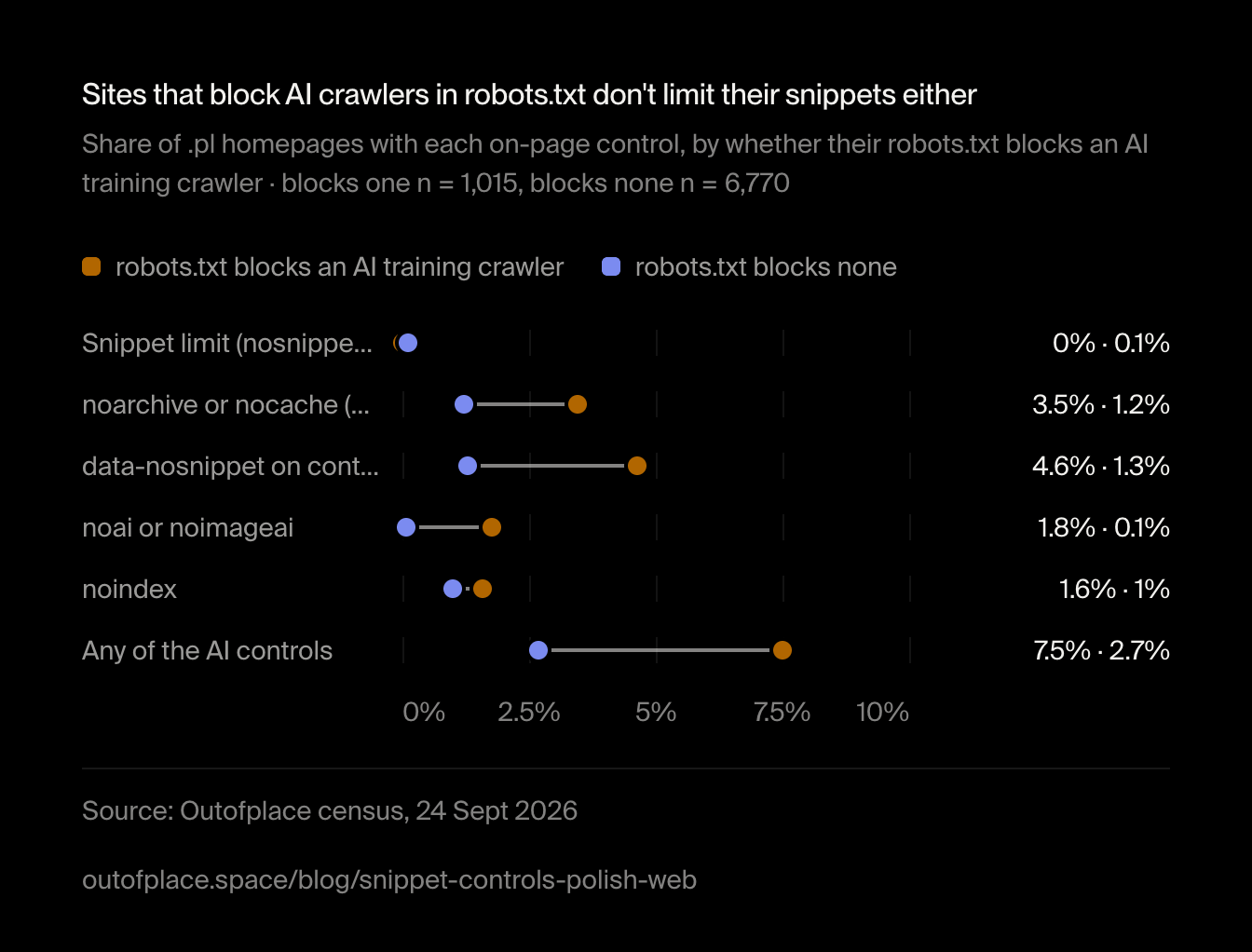
The chart as an image, free to reuse under CC BY 4.0 with credit to Outofplace and a link to this page.
The sites that block AI crawlers do use AI controls on the page more often than the rest, 7.5% against 2.7%, but the extra comes from data-nosnippet, Bing's noarchive and nocache, and AtomStore's noai, which 18 of the shops sending it pair with an AI block in robots.txt. The one rule Google names for AI Overviews is missing from all of them.
How to limit what Google and AI answers quote
A snippet rule is a trade. nosnippet keeps a page's text out of AI Overviews, and out of the snippet under its blue link in ordinary results too, which usually costs clicks. Decide per page, not per site.
Check what your site says today
Open the page's source and search for
name="robots", then look at the response headers in the browser's network panel forX-Robots-Tag. If you run WordPress with Yoast or Rank Math, you will most likely findmax-image-preview:large, max-snippet:-1: you have asked for more, not less.Limit text on the pages that need it
For a page whose text you don't want quoted, set a rule in its head.
max-snippetkeeps a short snippet;nosnippetremoves it:head <meta name="robots" content="max-snippet:50, max-image-preview:standard" /> <!-- or, to keep the text out of snippets and AI Overviews entirely --> <meta name="robots" content="nosnippet" />Hide one part of a page with data-nosnippet
Wrap a paragraph or block in a
div,spanorsectionwith the attribute; other elements are ignored:<div data-nosnippet>Prices change daily; check the product page.</div>Use X-Robots-Tag for files and whole paths
PDFs and images have no HTML head, so their rules go in a header. In nginx:
nginx.conf location ~* \.pdf$ { add_header X-Robots-Tag "nosnippet" always; }In Apache,
Header set X-Robots-Tag "nosnippet"inside a<FilesMatch "\.pdf$">block does the same.Add Bing's rule if Copilot matters to you
noarchivekeeps a page out of Bing's AI answers;nocachelets Bing show only its URL, title and snippet there. Neither affects Google.Don't block the page in robots.txt
A crawler blocked in robots.txt never reads the page's own rules. To keep a page's text out of AI Overviews, let Googlebot fetch it and tell it
nosnippet.
| Rule | What it asks | Limits | Homepages | Share |
|---|---|---|---|---|
| max-image-preview:large | Google may show large image previews, up to the width of the screen. | no | 1,937 | 25% |
| max-snippet:-1 | Google may choose the snippet's length, with no limit. | no | 1,357 | 17% |
| max-video-preview:-1 | Google may show video previews of any length. | no | 1,327 | 17% |
| noarchive | Bing keeps the page out of Bing Chat (now Copilot) answers; Google no longer uses it. | yes | 124 | 1.6% |
| noindex | The page stays out of search results, and so out of AI Overviews. | yes | 85 | 1.1% |
| noai | Unofficial: asks AI services not to use the content. | yes | 22 | 0.3% |
| nocache | Bing may use only the URL, title and snippet in Bing Chat (now Copilot) answers. | yes | 17 | 0.2% |
| max-image-preview:standard | Google may show only a default-sized image preview. | yes | 11 | 0.1% |
| max-snippet:n | Google may quote at most this many characters. | yes | 4 | 0.1% |
| nosnippet | No snippet, and the content isn't a direct input for AI Overviews and AI Mode. | yes | 3 | 0% |
| max-snippet:0 | No snippet, as nosnippet. | yes | 0 | 0% |
| max-image-preview:none | No image preview. | yes | 0 | 0% |
| noimageai | Unofficial: asks AI services not to use the images. | yes | 0 | 0% |
How we measured
What this data can't tell you
We saw the homepage only, as the server sent it. Article and product pages may carry other rules (publishers often set them per article), and a rule added by JavaScript or sent only for other paths is invisible. A homepage longer than 1 MiB was cut there (331 of them). We read what the sites ask; whether Google, Bing and AI services do as asked is their documentation's claim, which we didn't test. A cookie banner whose markup doesn't name cookies or consent is counted as content.
What is nosnippet?
A robots rule, set in a meta tag or the X-Robots-Tag header, that tells Google not to show a text snippet or video preview for the page. Google's documentation says it applies to every kind of result, AI Overviews and AI Mode included, and keeps the content from being used as a direct input for them. The page stays in the index and can still rank.
How do I hide part of a page from Google's snippets?
Wrap it in a div, span or section element with the data-nosnippet attribute: Google won't show that part in a snippet, and the rest of the page stays quotable. Google ignores the attribute on other elements. To limit the snippet for the whole page, use nosnippet, or max-snippet with a number of characters, in the robots meta tag.
What does data-nosnippet do?
It keeps one part of a page out of Google's snippets while the rest stays quotable. Google reads it only on span, div and section elements. On the Polish web it mostly hides cookie banners: 64% of the homepages that used it in September 2026 put it on a consent banner, so the banner's text never becomes the snippet.
What is X-Robots-Tag?
An HTTP response header that carries the same rules as the robots meta tag, such as noindex or nosnippet, set on the server instead of in the HTML. It is the only way to give rules for files without HTML, such as PDFs and images. Only 1.1% of Polish homepages sent one in September 2026.
X-Robots-Tag vs robots.txt: what is the difference?
robots.txt says whether a crawler may fetch a URL at all. X-Robots-Tag and the robots meta tag say what a search engine may do with a page it has fetched: index it, show a snippet, show an image preview. A crawler blocked in robots.txt never sees the page's own rules, so to keep a page out of results with noindex, don't block it in robots.txt.
Does Google-Extended keep my site out of AI Overviews?
No. Google says Google-Extended does not affect inclusion in Google Search; it covers training Gemini models and grounding in Gemini Apps and Vertex AI. AI Overviews and AI Mode are part of Search, so the controls for them are Googlebot's rules and snippet rules such as nosnippet, max-snippet and data-nosnippet.