Sitemap in robots.txt: a third of Polish files omit it
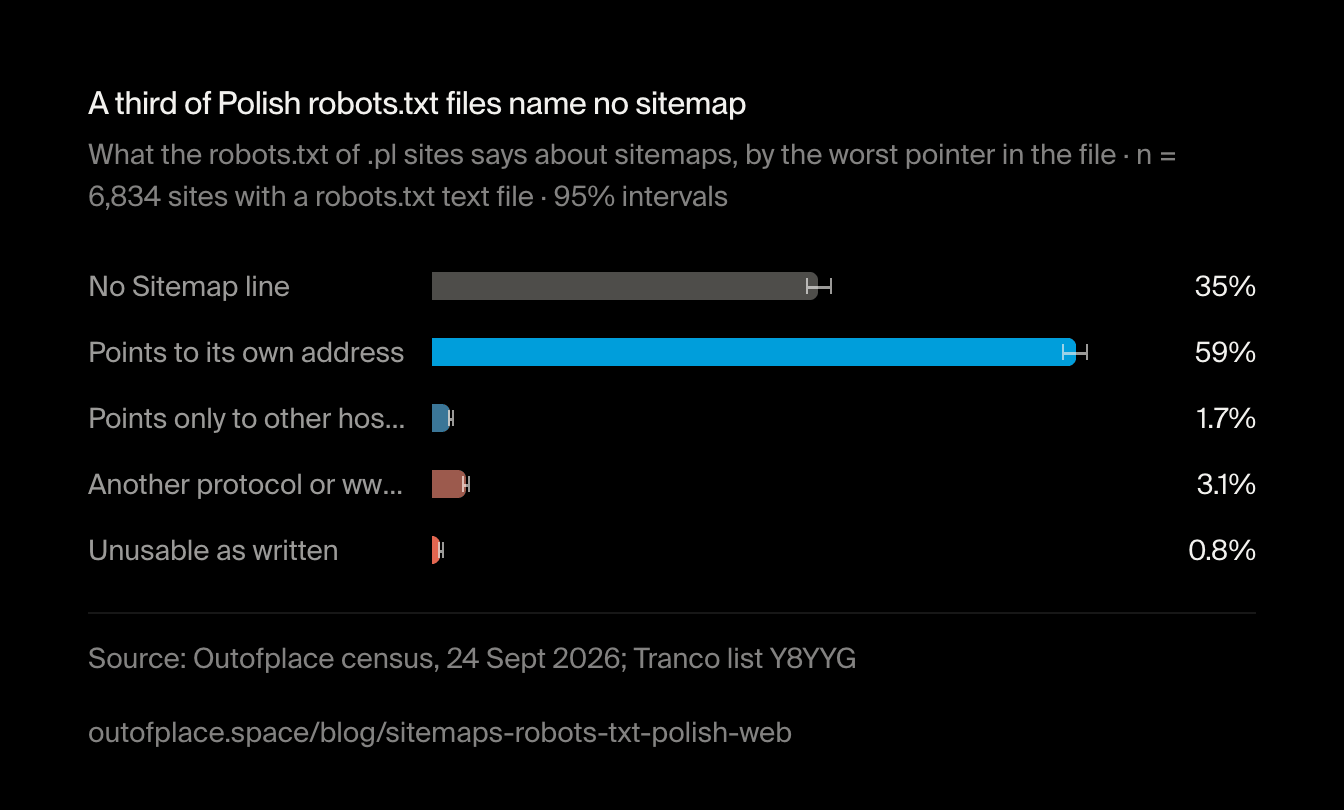
35% of 6,834 .pl sites with a robots.txt name no sitemap in it, and 6% of those that do point to a wrong address: http, the www twin or a relative path.


A third of Polish robots.txt files name no sitemap. We read the robots.txt files of the 6,834 .pl sites in the Tranco list of popular sites (opens in a new tab) that serve one, and 35% have no Sitemap: line. Of those that do, 6% point to an address the site doesn't serve as written: http on an https site, the www twin of the real host, a relative path, a test server.
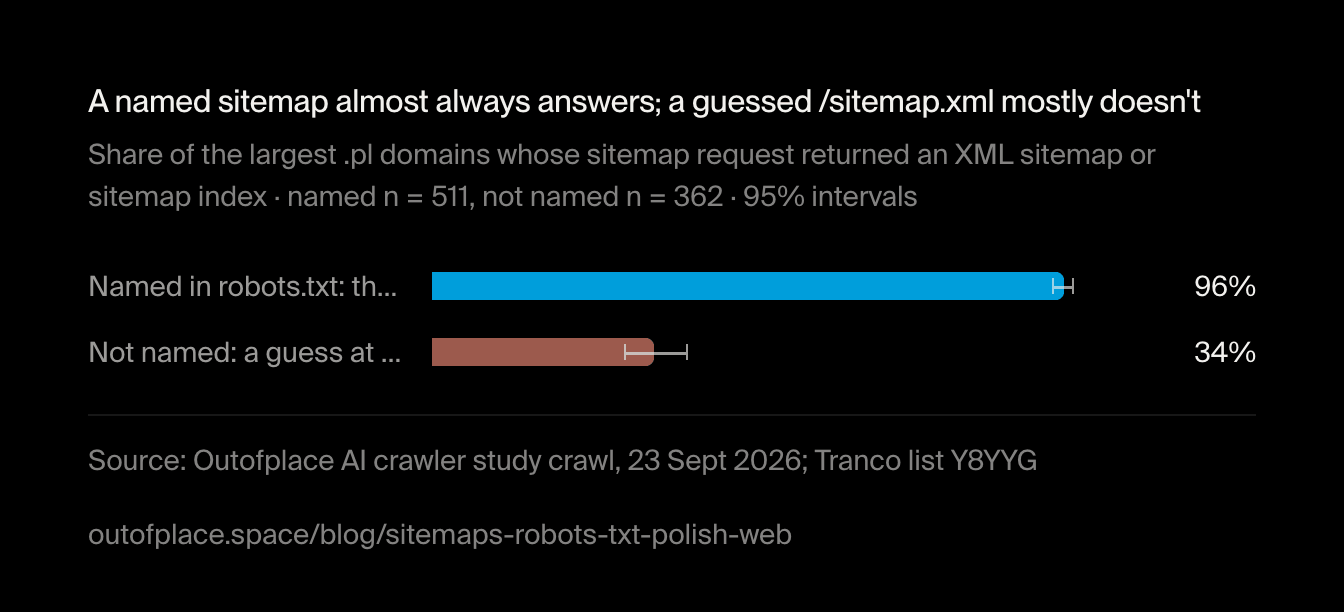
The line is the one place where every crawler, not just Google, learns where a site's list of pages is. When it's missing, crawlers are left to guess, and the guess often fails: on the largest Polish sites with no Sitemap: line, /sitemap.xml held a sitemap for only 34% of them. Whether the line is there goes with the platform behind the site, and wrong pointers are more common on sites where we recognised no platform than on those where we did. In our study of AI crawlers on the Polish web a sitemap listed where crawlers look for it was one of the basics Polish sites lagged on; this is the full census.
- 6,834
- 35%
- 6%
- 34%
What the Sitemap line in robots.txt does
A sitemap is a file, usually XML, listing the pages a site wants crawled, defined by the sitemaps.org protocol (opens in a new tab). A crawler can learn where it is in two ways: the site owner submits it in a search engine's own console (Google Search Console, Bing Webmaster Tools), which reaches that one engine, or the site names it in robots.txt, which every crawler reads first.
RFC 9309 (opens in a new tab), the robots.txt standard, doesn't define the line; it lists Sitemaps as an example of "other records" crawlers may read, and says such a record must not end a User-agent group. The rules come from elsewhere:
- sitemaps.org: the line holds "the full URL to the sitemap", and a file may name more than one. A sitemap's URLs must use its own protocol and host, unless the other host's robots.txt points to it (a "cross submit").
- Google's robots.txt documentation (opens in a new tab) (last updated 31 August 2026): the URL "must be a fully qualified URL, including the protocol and host", it "doesn't have to be on the same host as the robots.txt file", and any number of lines is fine. The line "isn't tied to any specific user agent".
So a correct line looks like this, anywhere in the file:
User-agent: *
Disallow: /cart/

Sitemap: https://www.example.pl/sitemap.xml
A third of Polish sites name no sitemap
Of the 7,785 sites whose homepage answered in our census, 951 served no robots.txt as a text file (most answered with a 4xx error, some sent an HTML page instead); they are left out. Among the rest, most sites name a sitemap and point to their own address. The second-largest group names none at all, and the groups that point wrongly are small but not rare.
A third of Polish robots.txt files name no sitemap
What the robots.txt of .pl sites says about sitemaps, by the worst pointer in the file · n = 6,834 sites with a robots.txt text file · 95% intervals
Show the data
| Item | Value | 95% interval | n |
|---|---|---|---|
| No Sitemap line | 35% | 34%–37% | 6,834 |
| Points to its own address | 59% | 58%–60% | 6,834 |
| Points only to other hosts | 1.7% | 1.4%–2% | 6,834 |
| Another protocol or www twin | 3.1% | 2.7%–3.5% | 6,834 |
| Unusable as written | 0.8% | 0.6%–1.1% | 6,834 |
The chart as an image, free to reuse under CC BY 4.0 with credit to Outofplace and a link to this page.
Size doesn't help. Among the sites in the sample's top 1,000, 59% name a sitemap, fewer than the 65% of the sites ranked below them. The gap goes with the mix of software. 74% of the top sites run nothing we recognise as a shop platform, an SEO plugin or WordPress, against 45% of the sites below them. Compared kind with kind, top sites and the rest name a sitemap about equally often: 52% against 55% where we recognised nothing, 76% against 74% where we did.
Should the sitemap be in robots.txt?
It isn't required: a search engine can find pages through links, and Google and Bing accept a sitemap submitted in their consoles. But a console reaches one engine, and every other crawler (Bing for a site only in Google's console, the AI crawlers, SEO tools) has the robots.txt line or a guess.
The AI crawler study fetched one sitemap per site for the largest 1,000 .pl domains on 23 September: the first Sitemap: URL when robots.txt names one, else /sitemap.xml, the conventional default. The two show what a crawler finds with the line and without it.
A named sitemap almost always answers; a guessed /sitemap.xml mostly doesn't
Share of the largest .pl domains whose sitemap request returned an XML sitemap or sitemap index · named n = 511, not named n = 362 · 95% intervals
Show the data
| Item | Value | 95% interval | n |
|---|---|---|---|
| Named in robots.txt: the first Sitemap URL | 96% | 95%–98% | 511 |
| Not named: a guess at /sitemap.xml | 34% | 29%–39% | 362 |
The chart as an image, free to reuse under CC BY 4.0 with credit to Outofplace and a link to this page.
96% of the named URLs answered with a sitemap. Without the line, /sitemap.xml did for 34% of the sites; the rest mostly answered with an error, some with an HTML page. Those sites may well have a sitemap elsewhere, submitted to Google, but a crawler that only reads robots.txt can't know.
Who writes the Sitemap line: the platform or nobody
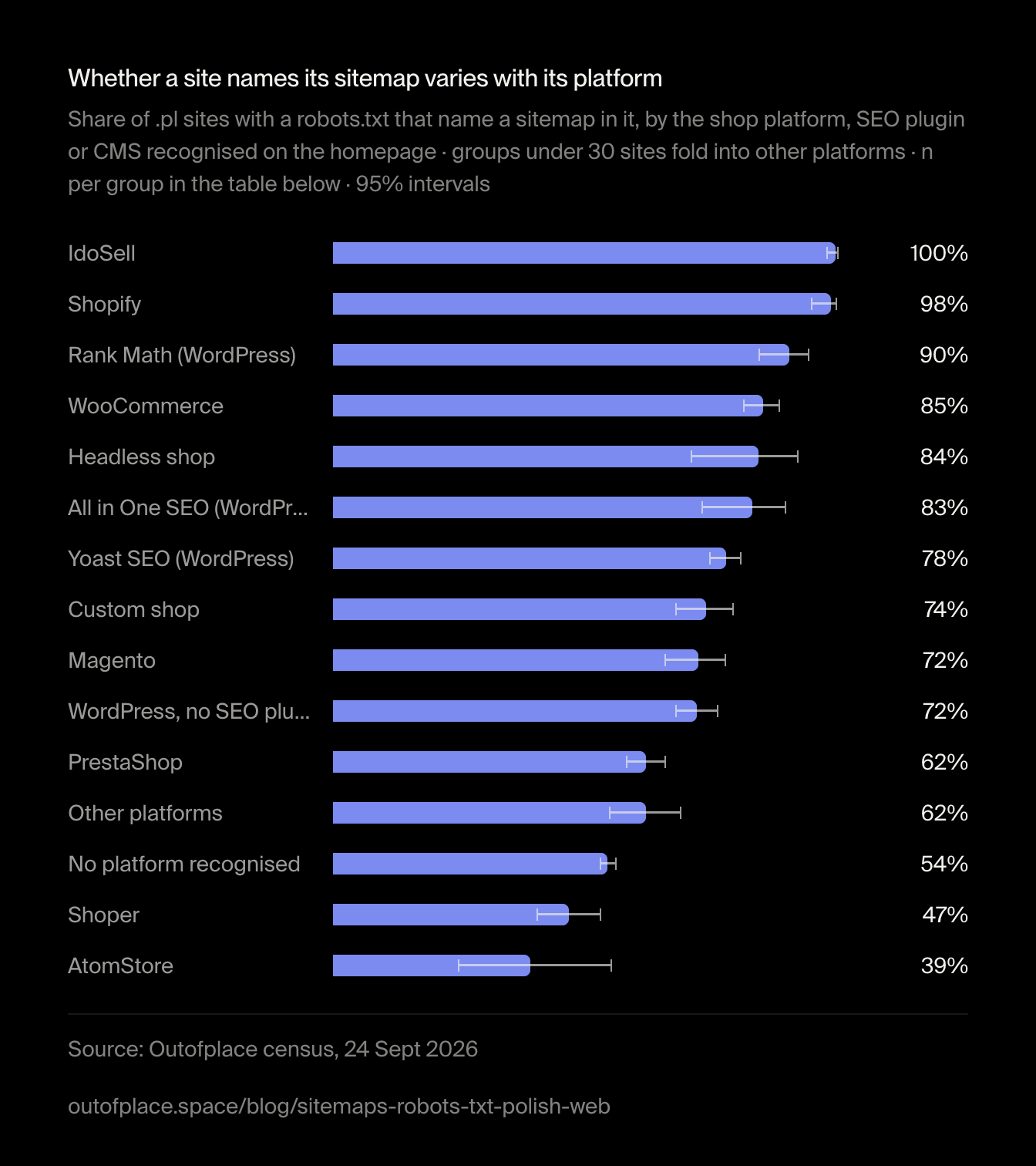
A CMS or shop platform can serve robots.txt itself, and then whether the file names a sitemap is up to the platform's settings. WordPress 5.5 (opens in a new tab) (2020) made its own robots.txt "reference the sitemap index" at /wp-sitemap.xml; SEO plugins replace it with their own.
Whether a site names its sitemap varies with its platform
Share of .pl sites with a robots.txt that name a sitemap in it, by the shop platform, SEO plugin or CMS recognised on the homepage · groups under 30 sites fold into other platforms · n per group in the table below · 95% intervals
Show the data
| Item | Value | 95% interval | n |
|---|---|---|---|
| IdoSell | 100% | 97%–100% | 217 |
| Shopify | 98% | 94%–100% | 127 |
| Rank Math (WordPress) | 90% | 84%–94% | 135 |
| WooCommerce | 85% | 81%–88% | 381 |
| Headless shop | 84% | 71%–92% | 44 |
| All in One SEO (WordPress) | 83% | 73%–90% | 76 |
| Yoast SEO (WordPress) | 78% | 74%–81% | 662 |
| Custom shop | 74% | 68%–79% | 214 |
| Magento | 72% | 66%–78% | 201 |
| WordPress, no SEO plugin found | 72% | 68%–76% | 437 |
| PrestaShop | 62% | 58%–66% | 553 |
| Other platforms | 62% | 54%–69% | 173 |
| No platform recognised | 54% | 53%–56% | 3,351 |
| Shoper | 47% | 40%–53% | 227 |
| AtomStore | 39% | 25%–55% | 36 |
The chart as an image, free to reuse under CC BY 4.0 with credit to Outofplace and a link to this page.
Hosted shop platforms sit at both ends. On IdoSell and Shopify nearly every shop names its sitemap. On Shoper and AtomStore about half of the shops in our sample or fewer name one, and the two can't be told apart (AtomStore is a small group of 36 shops). From robots.txt alone we can't tell whether that comes from a platform setting, a per-shop option or files the shops edit themselves. WordPress with an SEO plugin sits high, and the largest group, the sites where we recognised no platform at all, is close to the bottom with 54%.
File names point to platforms too. sitemap.xml is the most common, on 45% of the sites with a pointer to their own host, and some of the next names belong almost entirely to one kind of software, such as 1_index_sitemap.xml to PrestaShop and googlesitemap to Shoper:
| File name | Largest group of sites naming it | Sites | Share |
|---|---|---|---|
| sitemap.xml | No platform recognised (63%) | 1,892 | 45% |
| sitemap_index.xml | Yoast SEO (WordPress) (47%) | 942 | 22% |
| sitemap.xml.gz | IdoSell (89%) | 242 | 5.7% |
| 1_index_sitemap.xml | PrestaShop (98%) | 235 | 5.5% |
| wp-sitemap.xml | WordPress, no SEO plugin found (76%) | 222 | 5.2% |
| (no file name) | No platform recognised (76%) | 86 | 2% |
| googlesitemap | Shoper (100%) | 79 | 1.9% |
| sitemap-index.xml | No platform recognised (75%) | 77 | 1.8% |
How often is the sitemap pointer wrong?
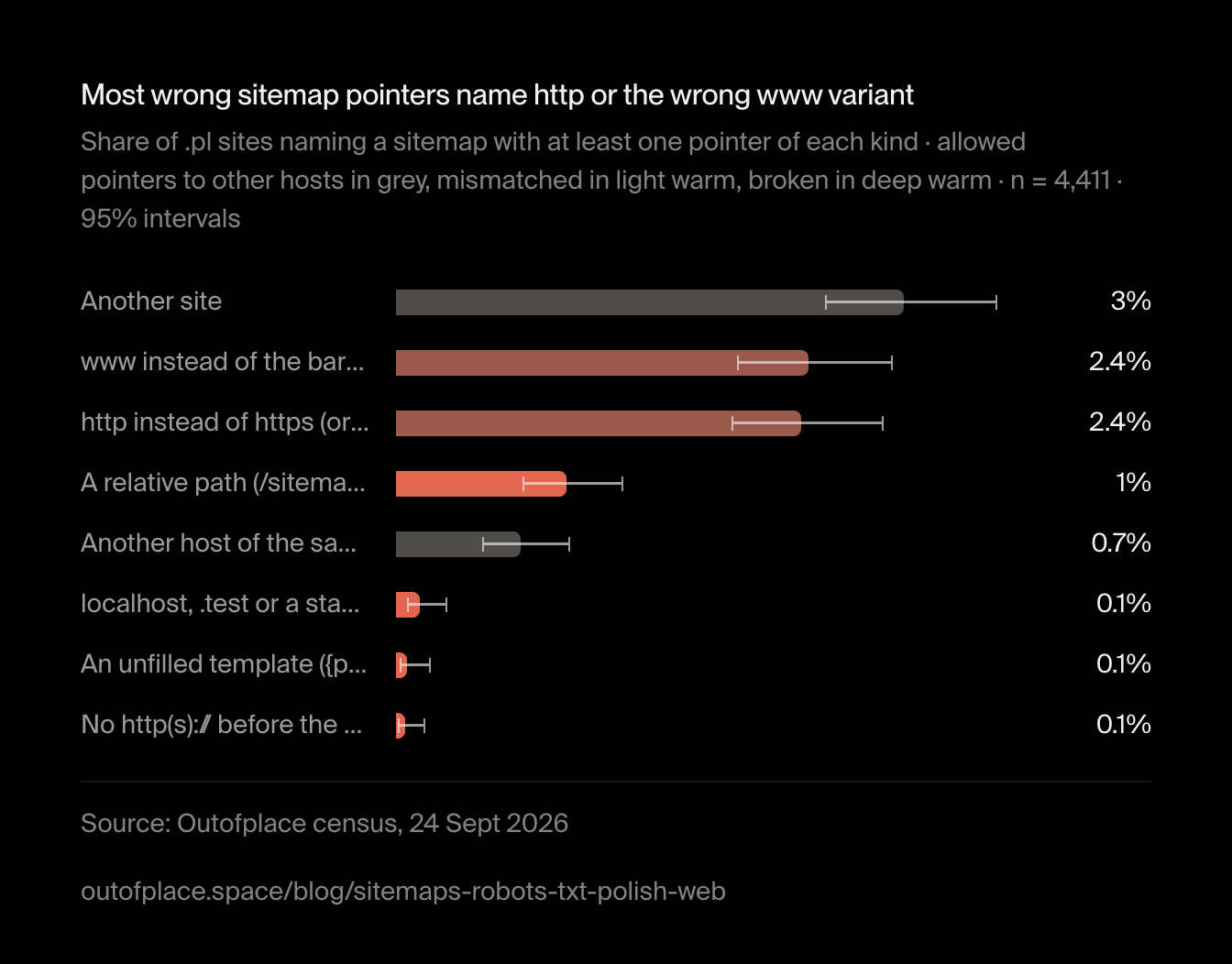
We sorted every Sitemap: value by what it points at, against the address the homepage actually landed on. Pointers to the site's own address are the norm. Pointers to another host are allowed by both Google and sitemaps.org and say nothing wrong on their own: a sitemap on a CDN, a shop's subdomain, a sister site. The rest fall into two groups.
- Mismatched: the site's own host with
httpinstead ofhttps(or another port), or thewwwtwin of the host the homepage lands on. These work only if the server redirects, and by the sitemaps.org rule a sitemap fetched fromhttp://speaks forhttp://URLs. - Broken: no usable address as written. A relative path such as
/sitemap.xml, which Google's rule for a fully qualified URL excludes; a host with nohttps://;localhost, a.testdomain or adev.host left over from staging; or a template whose placeholder was never filled in ({page_domain}/…,undefined/…).
Most wrong sitemap pointers name http or the wrong www variant
Share of .pl sites naming a sitemap with at least one pointer of each kind · allowed pointers to other hosts in grey, mismatched in light warm, broken in deep warm · n = 4,411 · 95% intervals
Show the data
| Item | Value | 95% interval | n |
|---|---|---|---|
| Another site | 3% | 2.5%–3.5% | 4,411 |
| www instead of the bare domain, or back | 2.4% | 2%–2.9% | 4,411 |
| http instead of https (or another port) | 2.4% | 2%–2.9% | 4,411 |
| A relative path (/sitemap.xml) | 1% | 0.7%–1.3% | 4,411 |
| Another host of the same site | 0.7% | 0.5%–1% | 4,411 |
| localhost, .test or a staging host | 0.1% | 0.1%–0.3% | 4,411 |
| An unfilled template ({page_domain}) | 0.1% | 0%–0.2% | 4,411 |
| No http(s):// before the host | 0.1% | 0%–0.2% | 4,411 |
The chart as an image, free to reuse under CC BY 4.0 with credit to Outofplace and a link to this page.
Together, 266 sites name at least one wrong address: 211 mismatched and 55 broken. That would matter less if the wrong line sat next to a right one, but it rarely does: 247 of them name no sitemap on their own address at all, and for 53 every pointer is broken.
Wrong pointers are more common where we recognised no software. Where a platform, plugin or WordPress was recognised, 4.1% of the sites naming a sitemap point wrongly; where none was, 8.8% do.
Multiple sitemaps in robots.txt
Most files name one sitemap: 85% of the sites that name any. The longest file we found lists 492. Google sets no limit, so a long list isn't an error, but it is a sign the site lists every sitemap where one sitemap index would do.
Most Polish sites name a single sitemap in robots.txt
Number of Sitemap lines in the robots.txt of .pl sites that name at least one · n = 4,411 · 95% intervals
Show the data
| Item | Value | 95% interval | n |
|---|---|---|---|
| 1 line | 85% | 84%–86% | 4,411 |
| 2 lines | 9.1% | 8.2%–9.9% | 4,411 |
| 3–5 lines | 3.3% | 2.8%–3.9% | 4,411 |
| 6–20 lines | 2% | 1.6%–2.5% | 4,411 |
| 21 or more | 0.5% | 0.4%–0.8% | 4,411 |
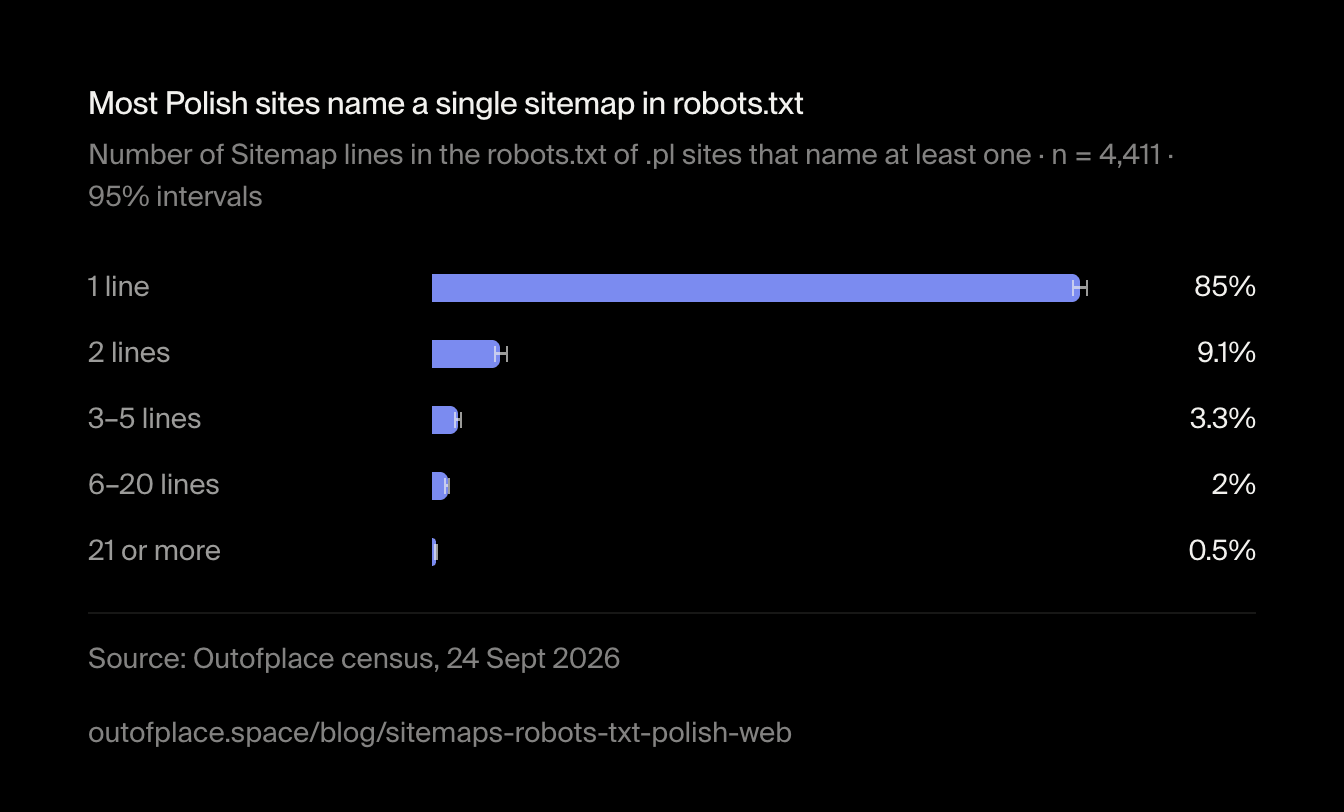
The chart as an image, free to reuse under CC BY 4.0 with credit to Outofplace and a link to this page.
Repeats are rarer: 45 sites list the same URL more than once, 115 extra lines in all. They do no harm, and they suggest a file that grew by copy and paste.
How to add a sitemap to robots.txt
Check what your robots.txt says now
Open
https://your-domain/robots.txtin a browser, or from a terminal:curl -s https://www.example.pl/robots.txt | grep -i '^sitemap'Finding no line at all is common. If your platform writes the file, look for the setting there before editing anything by hand.
Find the sitemap's real address
Open the address your homepage lands on and note its protocol and host:
https://example.plandhttps://www.example.plare different hosts to a crawler. The sitemap is usually at/sitemap.xml,/sitemap_index.xml(SEO plugins such as Yoast SEO) or/wp-sitemap.xml(WordPress without a plugin); open it and check that it is XML, not your 404 page.Write one full URL per line
Add the line anywhere in the file, outside or inside a group: it applies to every crawler either way.
robots.txt Sitemap: https://www.example.pl/sitemap_index.xmlNot
/sitemap.xml, notwww.example.pl/sitemap.xml, nothttp://on anhttpssite.Prefer one sitemap index to many lines
Under the sitemaps.org protocol (opens in a new tab), a sitemap holds up to 50,000 URLs and 50 MB uncompressed; past that, split it and list the parts in a sitemap index, which may list 50,000 sitemaps. Name the index in robots.txt. A sitemap on another host (a CDN, a subdomain) is fine when your robots.txt points to it.
Check it after every migration
Moving to
https, adding or droppingwww, or copying a staging site to production is when pointers go stale. Fetch robots.txt again after the move and open eachSitemap:URL.
| Software behind the site | Sites | Name a sitemap | Of those, wrong |
|---|---|---|---|
| IdoSell | 217 | 100% | 6% |
| Shopify | 127 | 98% | 0.8% |
| Rank Math (WordPress) | 135 | 90% | 0.8% |
| WooCommerce | 381 | 85% | 1.9% |
| Headless shop | 44 | 84% | 2.7% |
| All in One SEO (WordPress) | 76 | 83% | 6.4% |
| Yoast SEO (WordPress) | 662 | 78% | 4.7% |
| Custom shop | 214 | 74% | 3.8% |
| Magento | 201 | 72% | 2.8% |
| WordPress, no SEO plugin found | 437 | 72% | 6% |
| PrestaShop | 553 | 62% | 3.8% |
| Other platforms | 173 | 62% | 3.7% |
| No platform recognised | 3,351 | 54% | 8.8% |
| Shoper | 227 | 47% | 9.4% |
| AtomStore | 36 | 39% | 0% |
How we measured
What this data can't tell you
We read robots.txt as the server sent it; we didn't fetch the census sites' sitemaps, so a correct pointer to an empty or outdated sitemap counts as correct, and a mismatched one may well redirect to the right file. A text sitemap (one URL per line, which sitemaps.org allows) counts as no sitemap in the fetch test. Sites may submit sitemaps in Google Search Console or Bing Webmaster Tools, which we can't see: a missing line doesn't mean Google doesn't know the sitemap. The platform groups depend on what the homepage reveals; a site behind a custom theme may be filed under no platform.
Should the sitemap be in robots.txt?
It isn't required, but it is the one place every crawler looks. Submitting a sitemap in Google Search Console or Bing Webmaster Tools reaches only that search engine. In our September 2026 sample, a crawler that guessed /sitemap.xml on a large Polish site with no Sitemap line found a sitemap on 34% of them.
How do I add a sitemap to robots.txt?
Add a line with the sitemap's full URL, protocol and host included, anywhere in the file: Sitemap: https://www.example.pl/sitemap.xml. Use the address your site actually serves (https, and the host with or without www that your homepage lands on). The line isn't tied to any User-agent group.
Can the sitemap URL in robots.txt be relative?
No. Google's robots.txt documentation says the sitemap URL must be fully qualified, with the protocol and host, and the sitemaps.org protocol asks for the full URL too. A line like Sitemap: /sitemap.xml gives a crawler no address it is required to resolve.
Can robots.txt list multiple sitemaps?
Yes. Google accepts any number of Sitemap lines and the sitemaps.org protocol allows more than one per file. With many sitemaps, a single sitemap index file listing the rest keeps robots.txt short: under the sitemaps.org protocol an index may list up to 50,000 sitemaps.
Can the sitemap be on another domain?
Yes, if robots.txt points to it. Google says the sitemap URL doesn't have to be on the same host as robots.txt, and sitemaps.org's cross-submission rule uses the robots.txt line as proof that the site vouches for a sitemap kept elsewhere, on a CDN for example.