WordPress market share in Poland: a fifth of .pl sites
WordPress runs a fifth of popular Polish sites and half of those with a CMS we could see. On phones it passes Core Web Vitals like the rest; plugins matter.


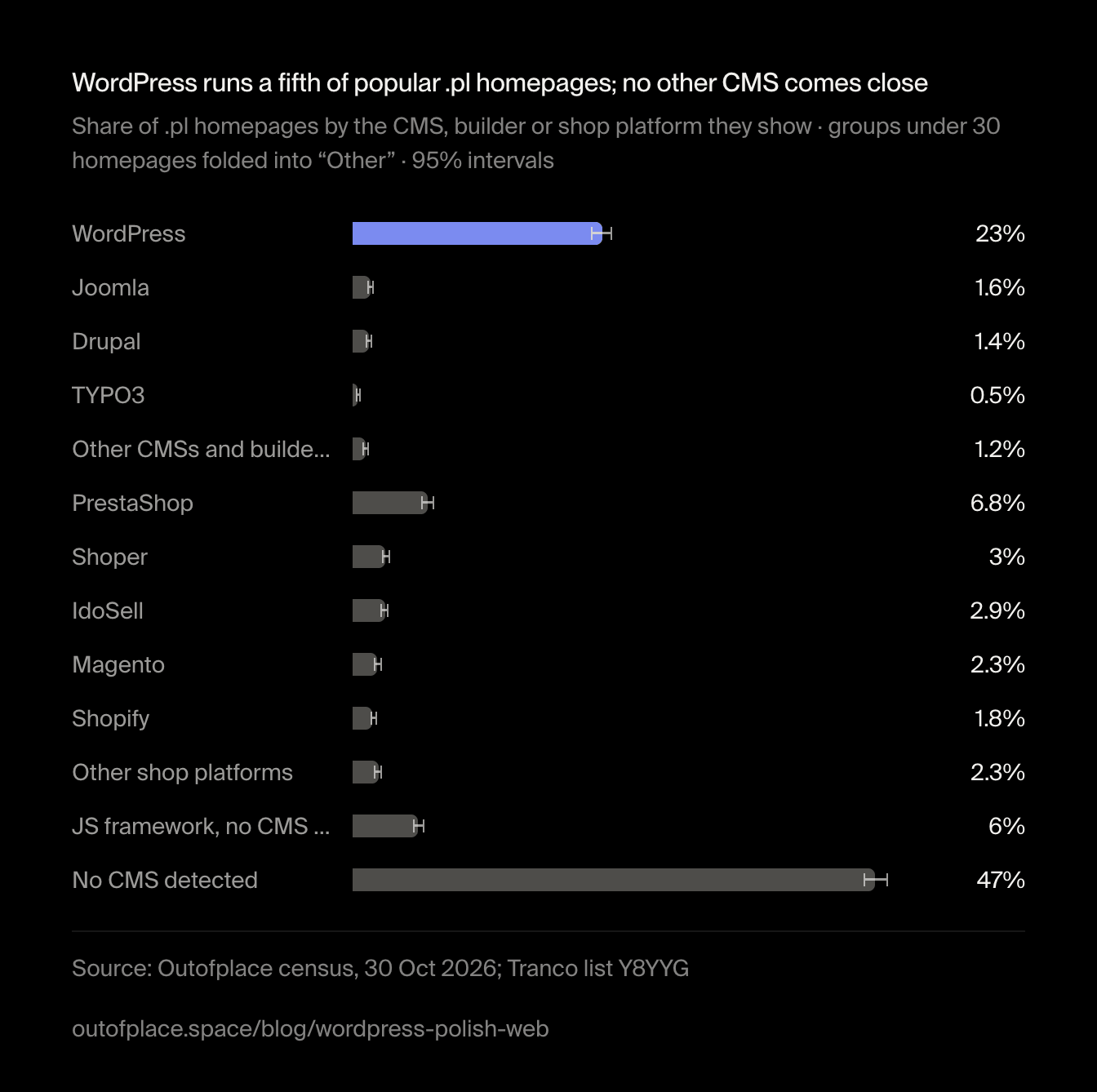
WordPress runs 23% of the popular Polish sites we read, a little over one in five, and 49% of those whose CMS or shop platform we could recognise. That makes it the most common CMS on the Polish web by far: PrestaShop, second, runs 6.8%. For real users on phones, WordPress sites do no worse than the rest: 58% pass all three Core Web Vitals, against 58% of other sites. What sets WordPress sites apart from each other is what they load: those with ten or more plugins on the homepage pass far less often than lean ones.
We read the homepages of every .pl site in the Tranco list of popular sites (opens in a new tab) that answered with HTML, the same sample as our studies of third-party scripts on Polish sites and Google Fonts and GDPR, and looked each site up in the Chrome UX Report (opens in a new tab), Google's record of how fast sites load for real Chrome users. Shops have our study of Core Web Vitals by ecommerce platform; this one maps every kind of site.
- 7,415
- 23%
- 49%
- 58%
What share of Polish sites run WordPress?
We sorted every homepage into one group by what its HTML, response headers and cookies show: a CMS (WordPress, Joomla, Drupal…), a site builder (Wix, Webflow…), a shop platform (PrestaShop, Shoper, IdoSell…), a JavaScript framework with no CMS behind it that we could see, or nothing recognisable. WooCommerce shops count as WordPress, since that is what they run on.
1,679 of the 7,415 homepages run WordPress. Every other CMS is small next to it: Joomla runs 1.6% and Drupal 1.4%, and the hosted site builders popular elsewhere, such as Wix and Webflow, barely register among popular .pl sites. The shop platforms come next, led by PrestaShop.
WordPress runs a fifth of popular .pl homepages; no other CMS comes close
Share of .pl homepages by the CMS, builder or shop platform they show · groups under 30 homepages folded into “Other” · 95% intervals
Show the data
| Item | Value | 95% interval | n |
|---|---|---|---|
| WordPress | 23% | 22%–24% | 7,415 |
| Joomla | 1.6% | 1.4%–1.9% | 7,415 |
| Drupal | 1.4% | 1.2%–1.7% | 7,415 |
| TYPO3 | 0.5% | 0.4%–0.7% | 7,415 |
| Other CMSs and builders | 1.2% | 0.9%–1.4% | 7,415 |
| PrestaShop | 6.8% | 6.2%–7.4% | 7,415 |
| Shoper | 3% | 2.6%–3.4% | 7,415 |
| IdoSell | 2.9% | 2.5%–3.3% | 7,415 |
| Magento | 2.3% | 2%–2.7% | 7,415 |
| Shopify | 1.8% | 1.6%–2.2% | 7,415 |
| Other shop platforms | 2.3% | 2%–2.7% | 7,415 |
| JS framework, no CMS seen | 6% | 5.5%–6.6% | 7,415 |
| No CMS detected | 47% | 46%–49% | 7,415 |
The chart as an image, free to reuse under CC BY 4.0 with credit to Outofplace and a link to this page.
The largest group is the one with no CMS we could recognise: 47% of homepages. Some are built in-house, some run a CMS that leaves no trace in the served HTML, and some sit behind a JavaScript front end; another 6% show a framework such as Next.js or Nuxt and no CMS at all. So every share here is of all homepages, not of all CMS installs.
WordPress market share among sites with a known CMS
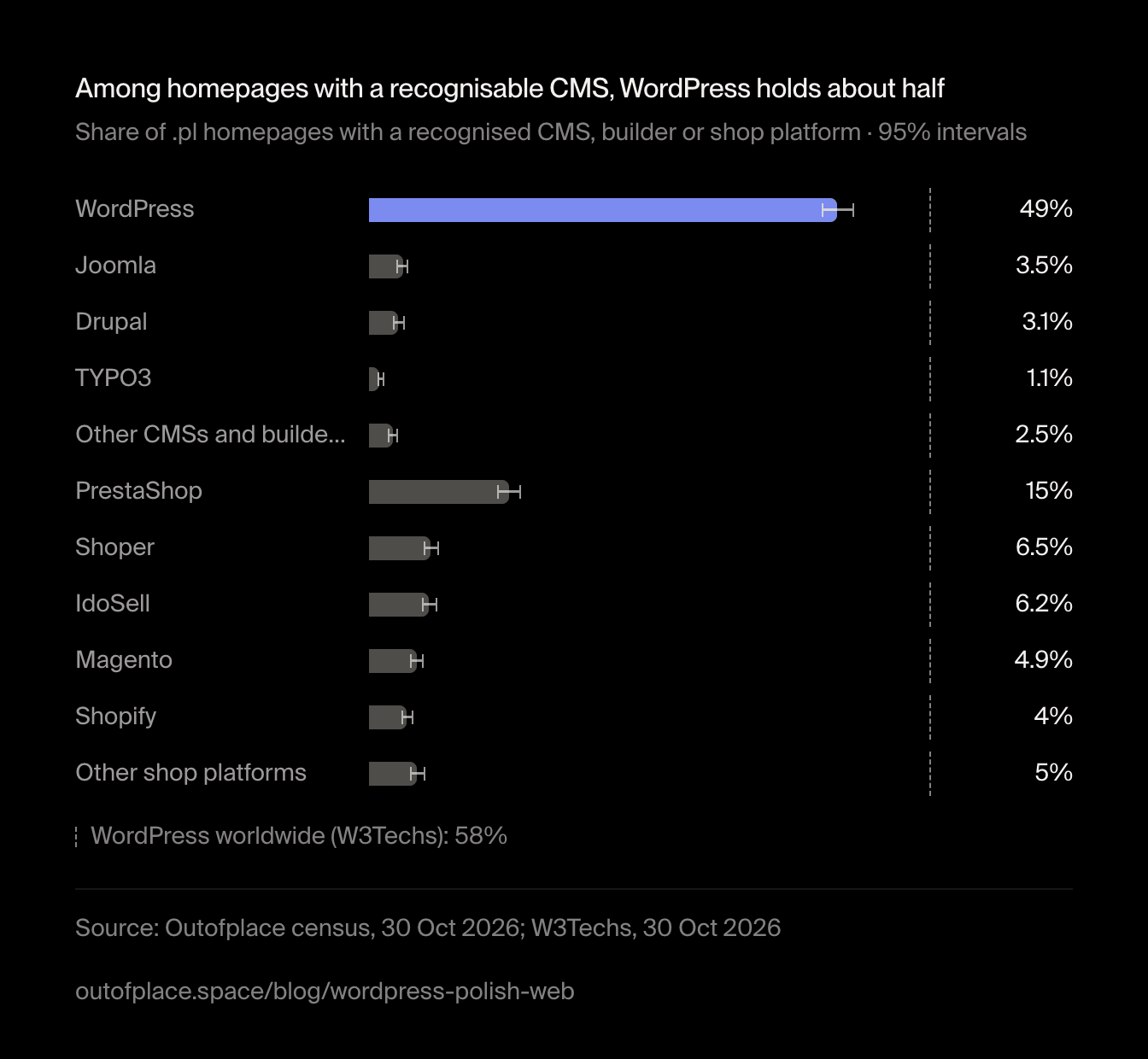
Counting only the 47% of homepages where we recognised a CMS, builder or shop platform, WordPress holds 49%. That is lower than W3Techs' worldwide figure of 58% (as of 30 October 2026), though W3Techs uses its own sample and its own detection, so the comparison is only a rough one. What our data does show is how much room shops take: shop platforms run 41% of the recognised homepages.
Among homepages with a recognisable CMS, WordPress holds about half
Share of .pl homepages with a recognised CMS, builder or shop platform · 95% intervals
WordPress worldwide (W3Techs): 58%
Show the data
| Item | Value | 95% interval | n |
|---|---|---|---|
| WordPress | 49% | 47%–50% | 3,448 |
| Joomla | 3.5% | 2.9%–4.2% | 3,448 |
| Drupal | 3.1% | 2.6%–3.7% | 3,448 |
| TYPO3 | 1.1% | 0.8%–1.5% | 3,448 |
| Other CMSs and builders | 2.5% | 2%–3.1% | 3,448 |
| PrestaShop | 15% | 13%–16% | 3,448 |
| Shoper | 6.5% | 5.7%–7.3% | 3,448 |
| IdoSell | 6.2% | 5.5%–7.1% | 3,448 |
| Magento | 4.9% | 4.3%–5.7% | 3,448 |
| Shopify | 4% | 3.4%–4.7% | 3,448 |
| Other shop platforms | 5% | 4.3%–5.8% | 3,448 |
The chart as an image, free to reuse under CC BY 4.0 with credit to Outofplace and a link to this page.
Which base a share is taken of matters as much as the share. On popular .pl sites WordPress is about half of the recognised CMSs, but a fifth of all homepages. For one sector up close, see what Polish law firm websites are built on.
Which CMS do the most popular Polish sites use?
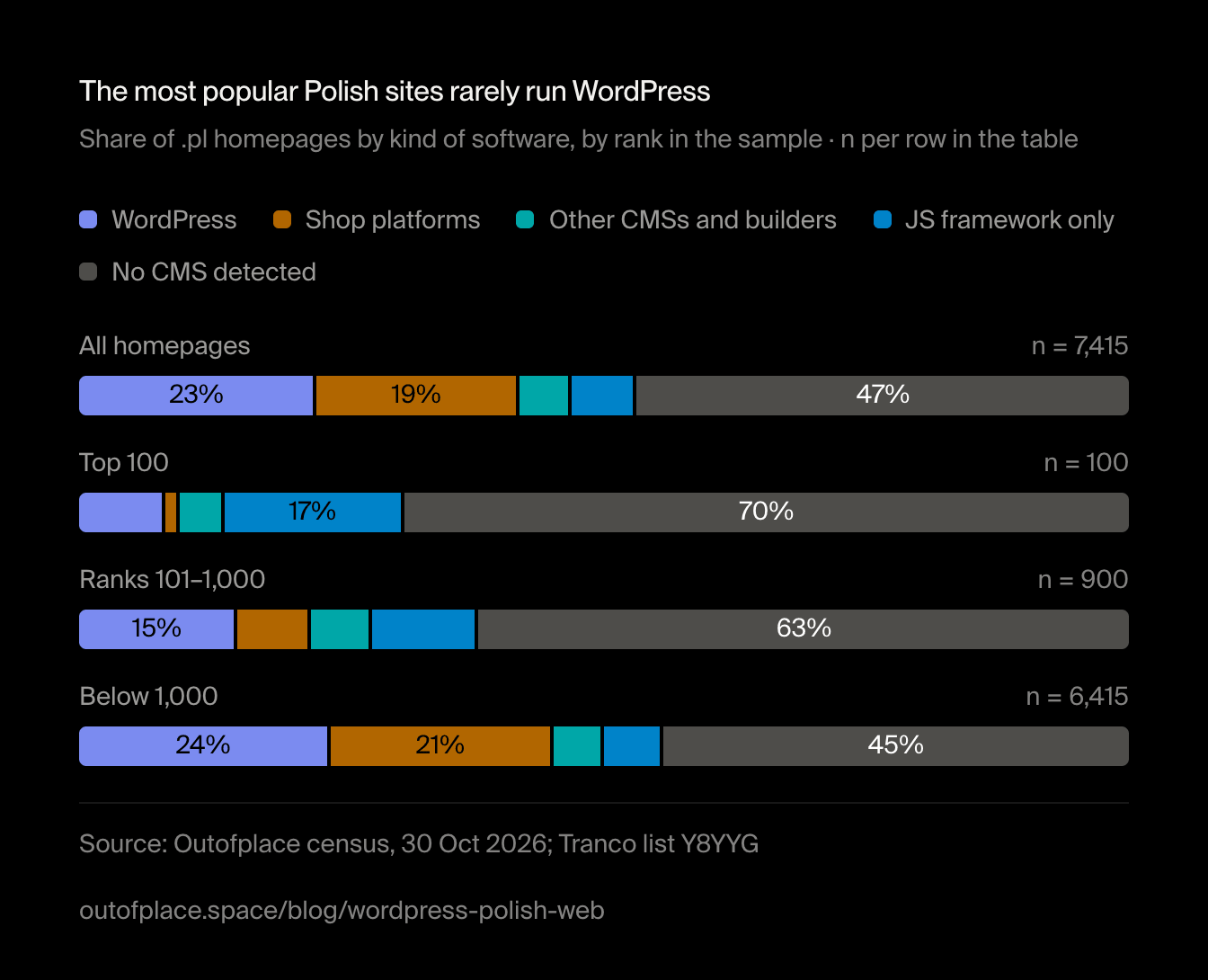
The bigger the site, the less likely it runs WordPress: 8% of the 100 most popular .pl homepages and 15% of the next 900, against 24% below rank 1,000. At the top, most homepages show no CMS we could recognise.
The most popular Polish sites rarely run WordPress
Share of .pl homepages by kind of software, by rank in the sample · n per row in the table
- WordPress
- Shop platforms
- Other CMSs and builders
- JS framework only
- No CMS detected
Show the data
| Item | WordPress | Shop platforms | Other CMSs and builders | JS framework only | No CMS detected | n |
|---|---|---|---|---|---|---|
| All homepages | 23% | 19% | 4.7% | 6% | 47% | 7,415 |
| Top 100 | 8% | 1% | 4% | 17% | 70% | 100 |
| Ranks 101–1,000 | 15% | 6.7% | 5.7% | 9.9% | 63% | 900 |
| Below 1,000 | 24% | 21% | 4.6% | 5.3% | 45% | 6,415 |
The chart as an image, free to reuse under CC BY 4.0 with credit to Outofplace and a link to this page.
Public administration is close to the average: 24% of the 82 gov.pl homepages in the sample run WordPress.
Does WordPress hurt Core Web Vitals?
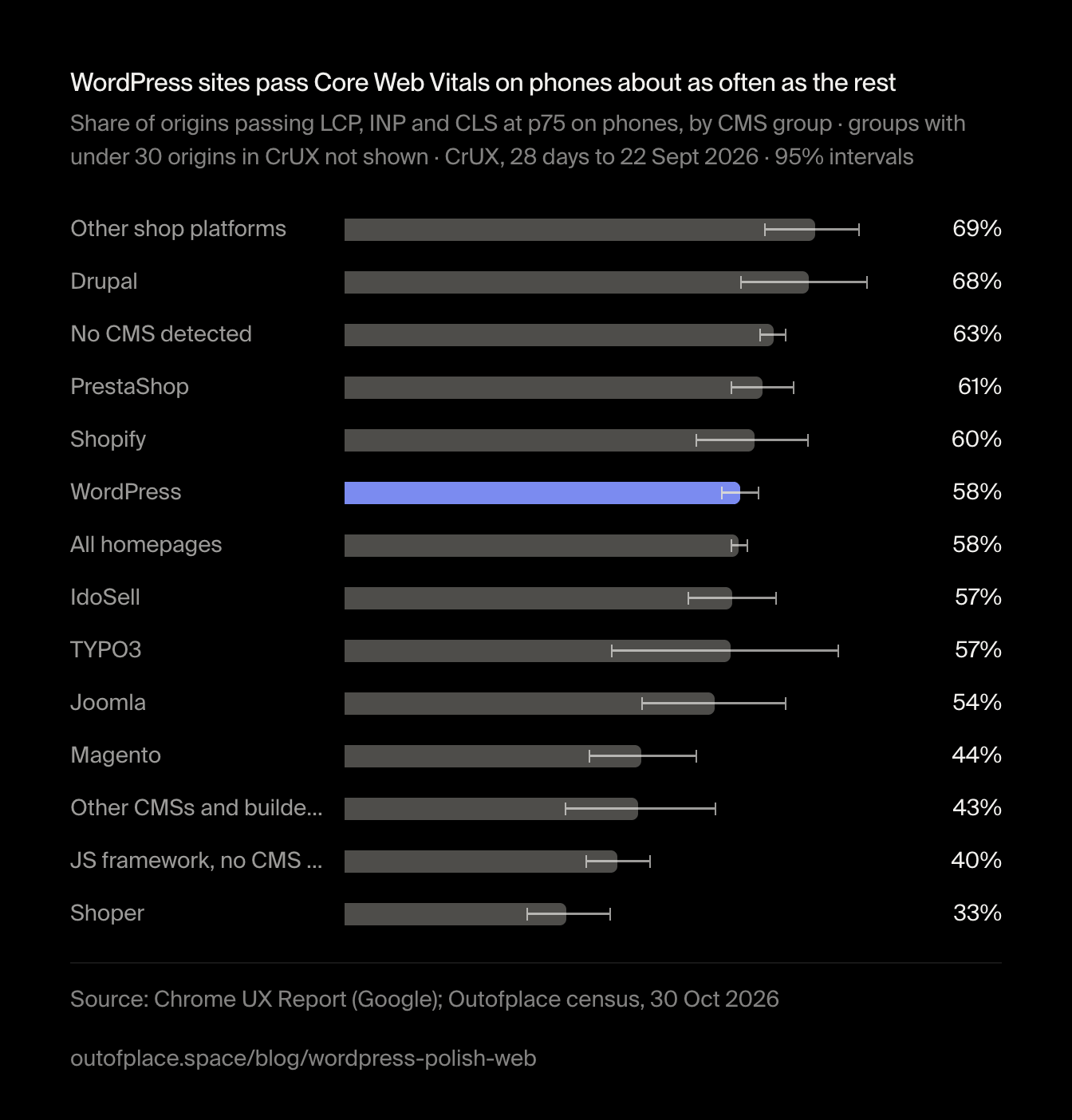
Not on average. An origin passes Core Web Vitals when, at the 75th percentile of its visits on phones, Largest Contentful Paint (LCP) is at most 2.5 seconds, Interaction to Next Paint (INP) at most 200 ms and Cumulative Layout Shift (CLS) at most 0.1. 58% of WordPress sites with enough Chrome traffic pass all three, against 58% of every other site: no detectable difference.
The groups that do differ are elsewhere. Homepages with no CMS we could see pass more often than WordPress; Drupal's point estimate is higher too, but with too few Drupal sites to be sure. Shoper shops are among the lowest, held back by INP, and so are sites with only a JavaScript framework, alongside Magento and the smaller CMSs.
WordPress sites pass Core Web Vitals on phones about as often as the rest
Share of origins passing LCP, INP and CLS at p75 on phones, by CMS group · groups with under 30 origins in CrUX not shown · CrUX, 28 days to 22 Sept 2026 · 95% intervals
Show the data
| Item | Value | 95% interval | n |
|---|---|---|---|
| Other shop platforms | 69% | 62%–76% | 162 |
| Drupal | 68% | 58%–77% | 91 |
| No CMS detected | 63% | 61%–65% | 2,316 |
| PrestaShop | 61% | 57%–66% | 410 |
| Shopify | 60% | 52%–68% | 128 |
| WordPress | 58% | 55%–61% | 1,227 |
| All homepages | 58% | 57%–59% | 5,492 |
| IdoSell | 57% | 50%–63% | 214 |
| TYPO3 | 57% | 39%–73% | 30 |
| Joomla | 54% | 44%–65% | 79 |
| Magento | 44% | 36%–52% | 149 |
| Other CMSs and builders | 43% | 32%–55% | 72 |
| JS framework, no CMS seen | 40% | 35%–45% | 396 |
| Shoper | 33% | 27%–39% | 218 |
The chart as an image, free to reuse under CC BY 4.0 with credit to Outofplace and a link to this page.
The average hides a trade. WordPress sites pass LCP less often than other sites, 78% against 85%: the main content takes longer to appear. They pass INP more often, 82% against 74%. A likely reason, which we didn't measure, is that a typical WordPress page is rendered on the server and runs less JavaScript after loading than a shop platform or a framework front end. The table has each metric for every group.
| CMS | Homepages | In CrUX | Pass all three | Good LCP | Good INP | Good CLS |
|---|---|---|---|---|---|---|
| No CMS detected | 3,522 | 2,403 | 63% | 88% | 78% | 84% |
| WordPress | 1,679 | 1,286 | 58% | 78% | 82% | 85% |
| PrestaShop | 501 | 423 | 61% | 82% | 82% | 86% |
| JS framework, no CMS seen | 445 | 401 | 40% | 72% | 55% | 74% |
| Shoper | 223 | 219 | 33% | 86% | 39% | 78% |
| IdoSell | 215 | 214 | 57% | 84% | 82% | 77% |
| Other shop platforms | 172 | 163 | 69% | 87% | 85% | 88% |
| Magento | 170 | 153 | 44% | 71% | 66% | 75% |
| Shopify | 137 | 129 | 60% | 92% | 70% | 93% |
| Joomla | 120 | 87 | 54% | 80% | 77% | 82% |
| Drupal | 107 | 91 | 68% | 90% | 85% | 86% |
| Other CMSs and builders | 86 | 73 | 43% | 79% | 69% | 71% |
| TYPO3 | 38 | 31 | 57% | 65% | 80% | 94% |
Do plugins slow WordPress down?
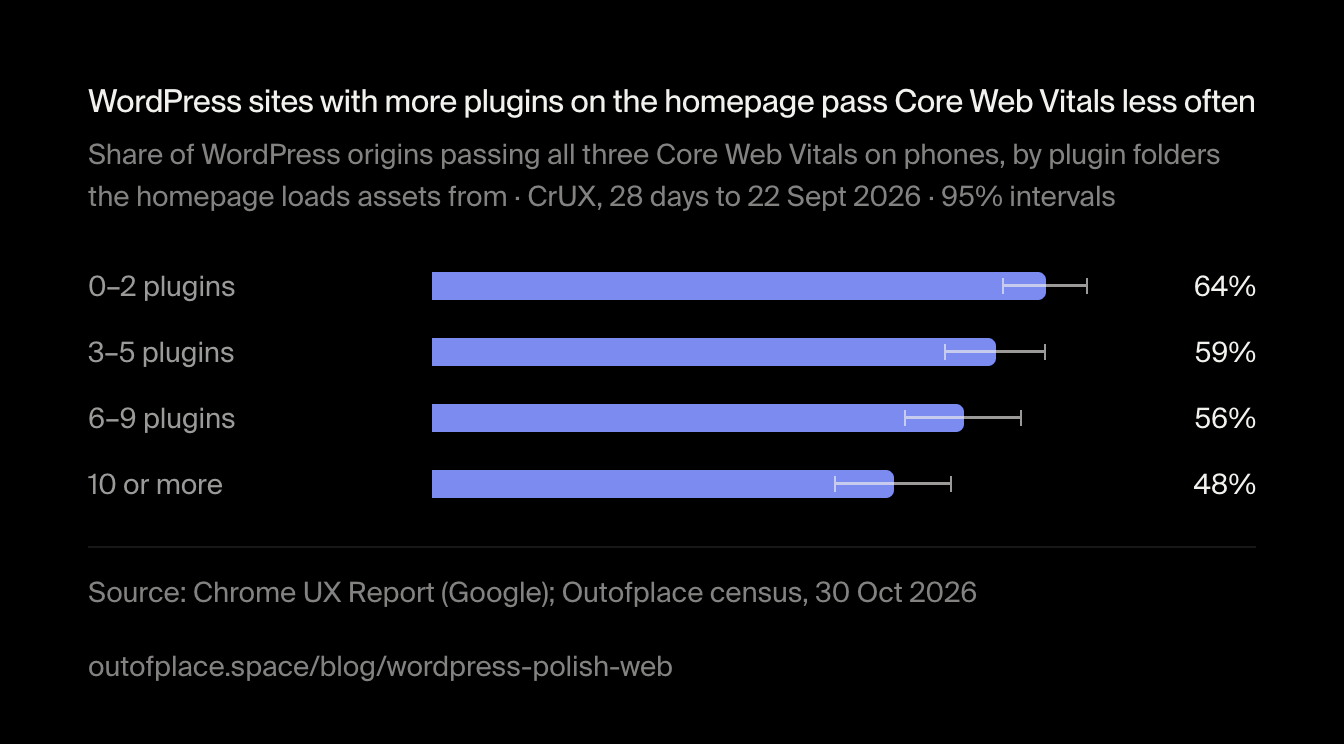
They go with it. We counted the distinct plugin folders a WordPress homepage loads scripts, styles or images from (/); the median homepage shows 4, and 17% show ten or more. The pass rate falls step by step as the count rises, from 64% with two or fewer to 48% with ten or more, and the drop is in LCP.
WordPress sites with more plugins on the homepage pass Core Web Vitals less often
Share of WordPress origins passing all three Core Web Vitals on phones, by plugin folders the homepage loads assets from · CrUX, 28 days to 22 Sept 2026 · 95% intervals
Show the data
| Item | Value | 95% interval | n |
|---|---|---|---|
| 0–2 plugins | 64% | 60%–69% | 421 |
| 3–5 plugins | 59% | 54%–64% | 318 |
| 6–9 plugins | 56% | 50%–62% | 240 |
| 10 or more | 48% | 42%–55% | 248 |
The chart as an image, free to reuse under CC BY 4.0 with credit to Outofplace and a link to this page.
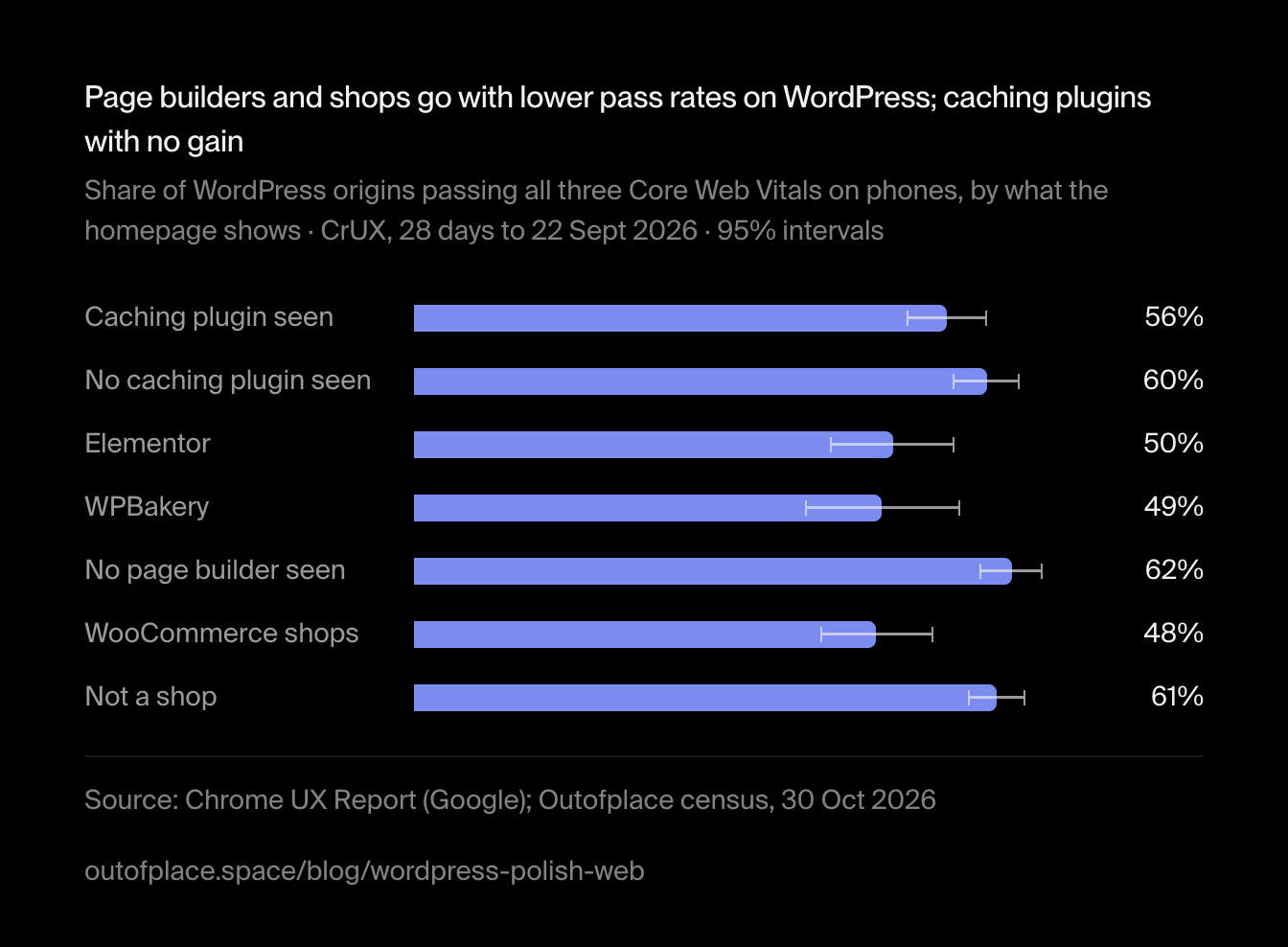
The same holds for what the plugins do. WordPress homepages built with Elementor pass 50% of the time, against 62% with no page builder we could see, and WooCommerce shops pass less often than WordPress sites that sell nothing. A caching or optimisation plugin, on the other hand, goes with no higher pass rate: 56% with one against 60% without.
Page builders and shops go with lower pass rates on WordPress; caching plugins with no gain
Share of WordPress origins passing all three Core Web Vitals on phones, by what the homepage shows · CrUX, 28 days to 22 Sept 2026 · 95% intervals
Show the data
| Item | Value | 95% interval | n |
|---|---|---|---|
| Caching plugin seen | 56% | 51%–60% | 515 |
| No caching plugin seen | 60% | 56%–63% | 712 |
| Elementor | 50% | 43%–57% | 222 |
| WPBakery | 49% | 41%–57% | 145 |
| No page builder seen | 62% | 59%–66% | 798 |
| WooCommerce shops | 48% | 43%–54% | 275 |
| Not a shop | 61% | 58%–64% | 952 |
The chart as an image, free to reuse under CC BY 4.0 with credit to Outofplace and a link to this page.
Which WordPress plugins are most popular?
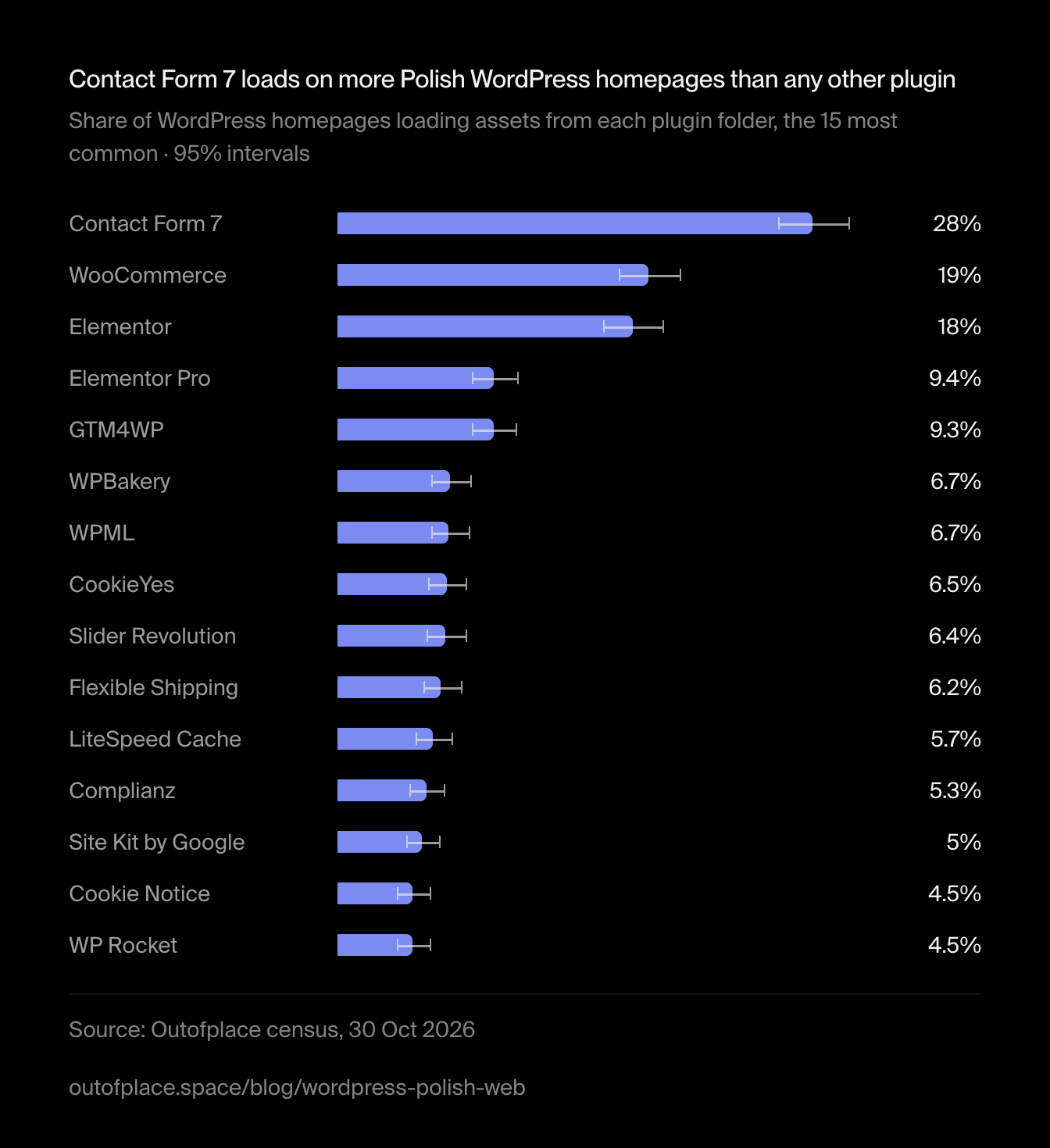
Contact Form 7 leads: 28% of WordPress homepages load its assets. WooCommerce, Elementor, Google Tag Manager for WordPress, WPBakery and the WPML translation plugin follow. These are the plugins visible on the homepage; plugins that add nothing to the front end, such as most SEO and security plugins, never show here.
Contact Form 7 loads on more Polish WordPress homepages than any other plugin
Share of WordPress homepages loading assets from each plugin folder, the 15 most common · 95% intervals
Show the data
| Item | Value | 95% interval | n |
|---|---|---|---|
| Contact Form 7 | 28% | 26%–31% | 1,679 |
| WooCommerce | 19% | 17%–21% | 1,679 |
| Elementor | 18% | 16%–20% | 1,679 |
| Elementor Pro | 9.4% | 8.1%–11% | 1,679 |
| GTM4WP | 9.3% | 8%–11% | 1,679 |
| WPBakery | 6.7% | 5.6%–8% | 1,679 |
| WPML | 6.7% | 5.6%–8% | 1,679 |
| CookieYes | 6.5% | 5.4%–7.8% | 1,679 |
| Slider Revolution | 6.4% | 5.4%–7.7% | 1,679 |
| Flexible Shipping | 6.2% | 5.1%–7.5% | 1,679 |
| LiteSpeed Cache | 5.7% | 4.7%–6.9% | 1,679 |
| Complianz | 5.3% | 4.3%–6.5% | 1,679 |
| Site Kit by Google | 5% | 4.1%–6.2% | 1,679 |
| Cookie Notice | 4.5% | 3.6%–5.6% | 1,679 |
| WP Rocket | 4.5% | 3.6%–5.6% | 1,679 |
The chart as an image, free to reuse under CC BY 4.0 with credit to Outofplace and a link to this page.
Caching plugins often leave no plugin folder in the page, so we also looked for their cache paths and comments. Counted that way, WP Rocket and LiteSpeed Cache are the most common, each on 9.2% and 9.3% of WordPress homepages; 38% show one caching or optimisation plugin or more.
Which WordPress versions do Polish sites run?
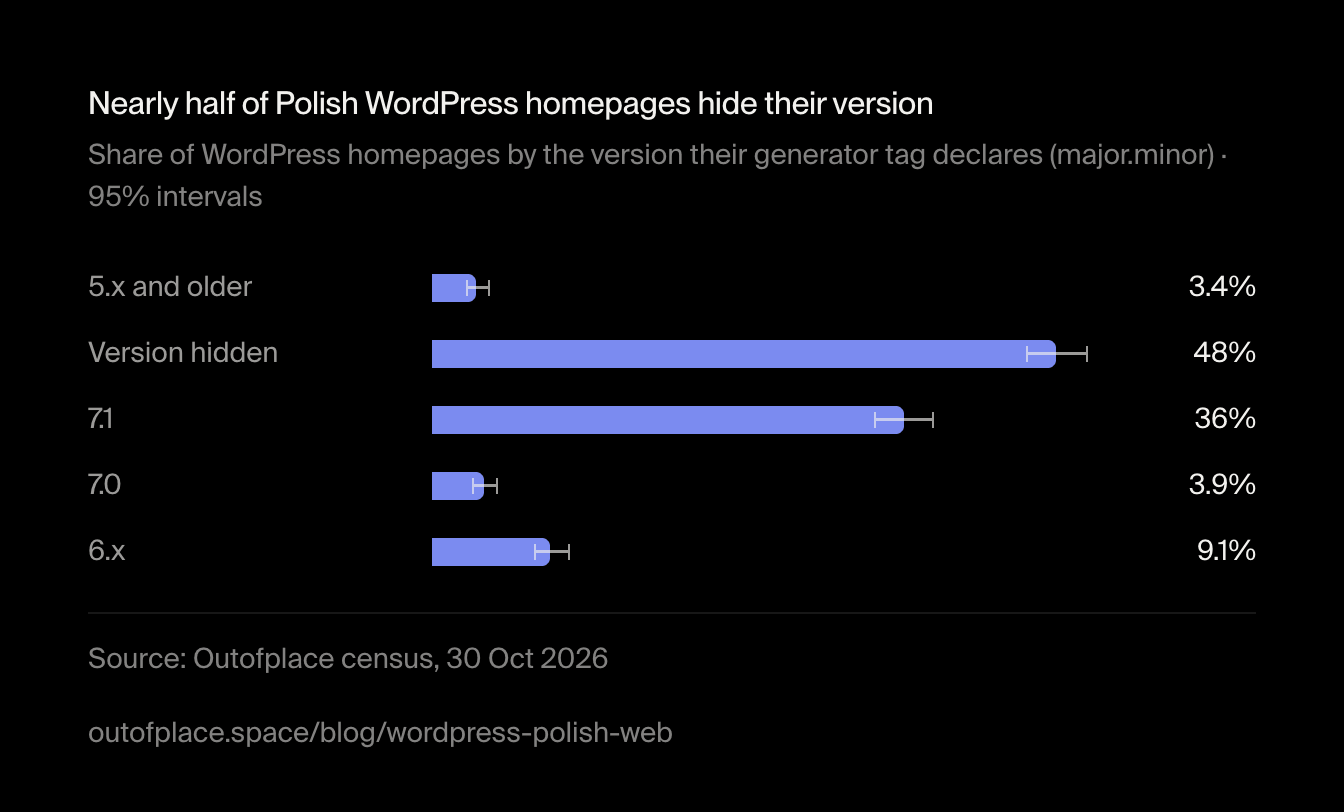
48% of WordPress homepages hide their version, which is the usual hardening advice. Of all WordPress homepages, 36% declare 7.1, the latest major release (WordPress releases (opens in a new tab)); the others that show a version declare 7.0, a 6.x release or something older.
Nearly half of Polish WordPress homepages hide their version
Share of WordPress homepages by the version their generator tag declares (major.minor) · 95% intervals
Show the data
| Item | Value | 95% interval | n |
|---|---|---|---|
| 5.x and older | 3.4% | 2.6%–4.4% | 1,679 |
| Version hidden | 48% | 45%–50% | 1,679 |
| 7.1 | 36% | 34%–38% | 1,679 |
| 7.0 | 3.9% | 3.1%–5% | 1,679 |
| 6.x | 9.1% | 7.8%–11% | 1,679 |
The chart as an image, free to reuse under CC BY 4.0 with credit to Outofplace and a link to this page.
How to check which CMS a website uses
Our rules automate checks anyone can do by hand in a browser, without a tool. They count a weak sign, such as a / path, only together with another one, and so should you:
Read the generator tag
Open the page source (Ctrl+U, or Cmd+Option+U on a Mac) and search for
generator. WordPress, Joomla, Drupal, TYPO3, Wix and Webflow write their name there by default, often with the version:<meta name="generator" content="WordPress 7.1.4">. Many sites remove it, so a missing tag proves nothing.Look for the CMS's own paths
Search the source for
/orwp-content/ /(WordPress),wp-includes/ /ormedia/ system/ js/ joomla-script-options(Joomla),drupal-settings-jsonor/(Drupal),sites/ default/ files/ /(TYPO3). Check that the path is on the site's own domain: a news site showing a picture from someone else's WordPress is not WordPress.typo3conf/ Check the response headers
In DevTools, open the Network panel, reload, click the first request and read its headers.
X-Generator: Drupal,X-Pingback: …/(WordPress),xmlrpc.php X-Wix-Request-Id(Wix) andx-powered-by: DCSaaS(Shoper) give the platform away even when the HTML doesn't.Look at the cookies
In the Application panel, list the cookies the first response set. Names such as
PrestaShop-…,wp_woocommerce_session_…orsoteshopname the platform outright.Accept that some sites won't tell
If none of this shows anything, the site is built in-house or hides its CMS behind a front end of its own. That was the case for almost half the homepages we read.
How to improve Core Web Vitals on WordPress
Our data points at the homepage's weight more than at any one tool. Count what the homepage loads before reaching for another plugin: every plugin folder in the page source (/) is code the browser fetches, and our sites with the fewest of them passed most often. Check LCP first, since that is where WordPress sites fall behind: make the main image or heading arrive early, and don't let a slider or a page builder's section hold it back. Then measure for real users in PageSpeed Insights (opens in a new tab) or Search Console, which show the same Chrome UX Report data we used, over 28 days. Lab tests and field data often disagree; our guide explains why lab and field numbers differ.
How we measured
How we checked the classification
We drew a seeded random sample of homepages from each group (eight WordPress, five each of Joomla, Drupal and framework-only, and ten with no CMS detected) and read their HTML, headers and asset paths by hand. All 23 labelled with a CMS or framework were right (23 of 23). Of the 10 with no CMS detected, 9 really showed none; the other runs CMCMedia, a Polish news CMS our rules don't list. Shop platforms come from the classifier of our shop study, checked there. The sample is small, so it rules out gross errors, not small ones; the labels are in the dataset.
What this data can't tell you
We saw the homepage only, as its HTML arrived, and ran none of it. A CMS that hides its traces, or sits behind a front end of its own, counts as "no CMS detected", so every share here is a floor. Plugins show only when the homepage loads their files, and an optimiser that bundles files hides them. The field data covers every page of a site, not just the homepage, and comes from five weeks before the census; a site that changed its CMS in between is counted with its new one, and sites new since the September census have no speed data. More sites blocked our crawler with a bot challenge than in September, and homepages over 1 MiB were cut, which can hide plugins and markers further down. Every speed difference here is a correlation between sites: they also differ in hosting, theme, size and audience.
What share of Polish websites use WordPress?
Of the 7,415 popular .pl homepages we read on 30 October 2026, 23% run WordPress, and 49% of those whose CMS or shop platform we could recognise. It is the most common CMS on the Polish web by a wide margin; PrestaShop is second with 6.8% of all homepages.
Is WordPress losing market share?
Worldwide, W3Techs' survey puts WordPress at 40% of all sites and 58% of sites with a known CMS on 30 October 2026. For Poland we have one measurement, so we can't say yet whether its share is falling here. What we can say is that it is lower among the most popular sites: 8% of the top 100 .pl homepages, against 24% below rank 1,000.
Does WordPress hurt Core Web Vitals?
Not on average. 58% of WordPress sites with Chrome UX Report data pass all three Core Web Vitals on phones, against 58% of all other sites. WordPress sites pass LCP less often and INP more often. Inside WordPress the spread is wide: sites whose homepage loads assets from ten or more plugins pass 48% of the time, those with two or fewer 64%.
What is a good LCP, INP and CLS score?
Google calls a page good when, at the 75th percentile of visits, Largest Contentful Paint is at most 2.5 seconds, Interaction to Next Paint at most 200 milliseconds and Cumulative Layout Shift at most 0.1. A site passes Core Web Vitals when all three are good, measured separately for phones and desktops.
How do I check which CMS a website uses?
Open the page source and look for a generator meta tag, then for the CMS's own paths on the site's domain: /wp-content/ for WordPress, joomla-script-options for Joomla, drupal-settings-json for Drupal. Response headers (X-Generator, X-Pingback) and cookie names give many platforms away too. If nothing shows, the site is custom-built or hides its CMS.